
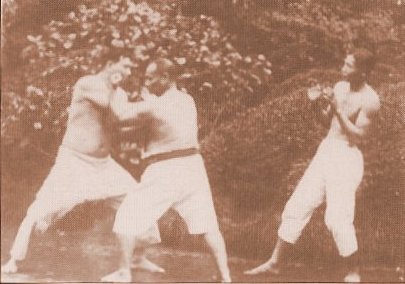
Choki Motobu was born in Shuri, Okinawa city, in 1871. He was the third son of Akahira’s governor, Chomo Motobu, a descendant of Sho Shitsu, who was king of Okinawa from 1648 to 1668, keepers of an old fighting tradition in a style of Kenpo called Udon-Te (Palace Art) or Motobu-Te (Family Hands).
From a young age, Choki showed amazing physical health and quickness, earning him the nickname “Saru” (monkey) from the locals. Being the third child, learning the family system, given to the firstborn, was not a main concern. It was only when he turned 12 that he started taking To-de (Okinawa-te) lessons from his elder brother, Choyu, but his proud nature (which often got him into fights) gained him a bad name, making it hard for him to be taken on as a student by other local To-de teachers. As a result, his growth was mainly that of a self-taught learner, although it is known that he sometimes learned from Ankoh Itosu, Pechin Tokumine, and Kohsaku Matsumora. Choki Motobu was the cousin and training partner of another well-known To-de fighter: Chotoku Kyan.
Biography Choki Motubo – Kenpo Karate
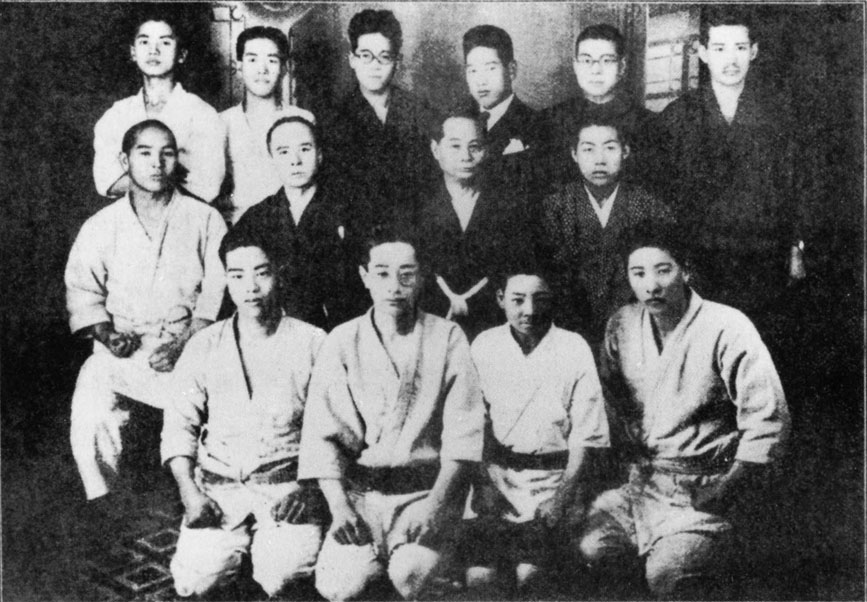
–His life was fighting and to this he dedicated most of his efforts.
His personality is said to have been strong and bellicose, even tending towards violence. His only goal was to be the best fighter in Okinawa. Although he studied traditional kata, being a specialist in Naifanchi kata, his great passion has always been kumitê, preferring the study of traditional kata.
–His life was governed by countless battles and challenges. During his youth, fights between different schools were frequent, in which Choki Motobu often participated.
He liked to wander the most dangerous neighborhoods at night to face dangerous situations and fight. He has won countless fights against the most diverse styles and fighters, from other karateka to jujutsu practitioners and foreign fighters. Naturally he also suffered several defeats against experienced fighters, from which he drew various conclusions for his improvement, even training with some of them.
Although he was physically advantaged, he trained regularly with weights and was a big fan of makiwara work, from which he did not stray too far.
Motobu had a great preference for open hand and uraken (back of the fist) strikes. The writer David Leonardo Bárcena says that his student Katsuya Miyahira remembered that Motobu hit the makiwara with the ippon ken (a punch that highlights the second phalanx of the index finger), with which he practiced numerous KOs on his opponents.
In 1921, when he decided to leave for Osaka, in Honshu (the central island of Japan), his fame as a fighter had already spread throughout the Ryu-kyu territory. As soon as he arrived, he immediately began to make himself known, launching public challenges and beating several Ju-jutsu and Boxing champions, the most famous fight being against a Russian. This huge fighter had defeated several Japanese from different schools and challenged everyone to fight. Master Motobu, then fifty years old, accepted the challenge and quickly surpassed it. Some sources even report that the Russian fighter died a few days later. This was one of the first public appearances of Kenpo Karate in Japan, even before Funakoshi’s famous demonstration in 1922.
–Choki Motobu was the author of one of the first Kenpo Karate books in Japanese, «Okinawa Kenpo Karate Jutsu».
Some of his students were Shoshin Nagamine (10th dan Matsubayashi ryu), Katsuya Miyahira (10th dan Kobayashi Shorinryu) and Masayoshi Mitose (founder of Kara Ho Kenpo), responsible for bringing his art to the West.
–Master Motobu died in Naha, Okinawa, around 1944. After his death, his son Chosei Motobu and Seikichi Uehara continued his work, creating Motobu Ryu in 1947. In 1969 Uehara founded the Motobu Ryu Kobujutsu Association.
Choki Motobu: The Brawler Who Defined Karate
Choki Motobu was born in Shuri, Okinawa city, in 1871. He was the third son of the governor of Akahira, Chomo Motobu, a descendant of Sho Shitsu, king of Okinawa between 1648 and 1668, and was raised within a family that were guardians of an ancient martial tradition in the form of a style of Kenpo called Udon-Te (Palace Art) or Motobu-Te (Family Hands). This ancestral connection placed him within the highest echelons of Okinawan society.
From an early age, Choki demonstrated extraordinary physical fitness and agility, so much so that he was nicknamed “Saru” (monkey) by locals—a moniker that spoke to his acrobatic prowess and quick reflexes. However, since he was the third child, teaching the intricacies of his clan’s system, traditionally taught only to the firstborn, was not a priority. This initial lack of formal, dedicated instruction steered Motobu onto a unique, self-directed path in his martial development.
It was only at the age of 12 that he began receiving To-de (Okinawa-te) lessons from his older brother, Choyu, who would later found the Motobu-ryū style. Despite this training, Choki’s arrogant character and fiery temperament led him to often get involved in physical disputes, earning him a bad reputation. This notoriety made it difficult for him to be accepted as a dedicated disciple of other leading local To-de teachers. Thus, his progress was essentially that of an autodidact, training relentlessly in solitude and using real-life encounters—often informal street fights—as his proving ground. Although his primary method was self-practice, it is known that he occasionally received lessons from respected masters like Ankoh Itosu, Pechin Tokumine, and Kohsaku Matsumora, integrating their knowledge into his own practical style. Choki Motobu was also the cousin and practice partner of another famous To-de name: Chotoku Kyan.
Motobu’s fame surged dramatically in 1921 when, while living in Osaka, Japan, he participated in a public challenge match against a large, Western boxer. Though much smaller, Motobu knocked out his opponent with a decisive strike. This event, sensationalized in Japanese media, was instrumental in popularizing Okinawan Karate throughout mainland Japan during the early 1920s, paving the way for figures like Funakoshi Gichin. Motobu emphasized the practical application (bunkai) of kata, arguing that many masters of his time focused too much on demonstration and not enough on real fighting efficacy—a philosophy heavily influenced by his rough, real-world training.
latest posts published
What does the name of our dojo “ishin denshin” mean?

Water: the elixir of life and the secret to optimal hydration
Sempai, Kohai and Dohai: respect for the hierarchical system
What is a dojo (道場)? | At the origins of the word
Mitsu no sen (three points) les trois principals initiatives
Karate Belts: Understanding the Order of Ranks
The concept of “Giri”, a profound moral commitment
Kyokun Martial – In karate there is no first attack.
The social economy at the heart of our martial arts center
