
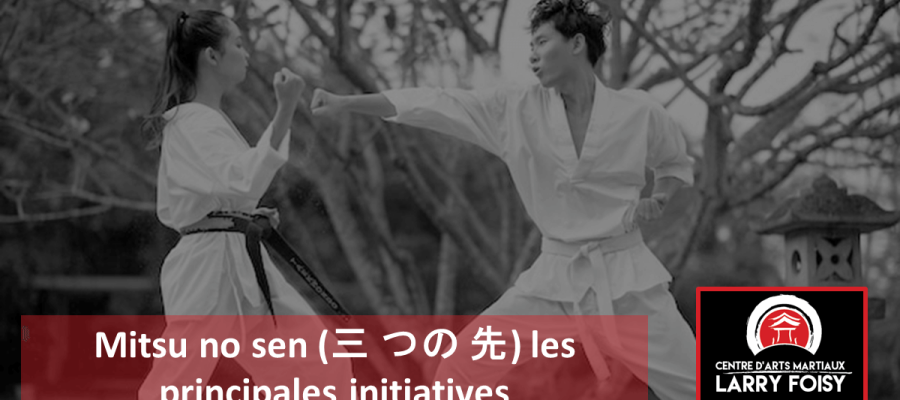
Although it is usual to utilize the three verb times which are before, during and after to express a basic fact of life, it is often clearer in the practice of martial arts. Therefore, it is typical to use Sen-no-sen, Tai-no-sen, and Go-no-sen for ease of understanding, but there are some details to consider. For example, the past refers to a moment ago and the exact time you just completed reading these words. The same goes for the future.
While «Sen» is usually viewed as before, I believe it is better to interpret «sen» as the purpose which implies that Sen-no-sen means intention during intention rather than attack during attack. By thinking of «sen 先» as a purpose, we free ourselves from the fact that once we choose and plan to perform an action, an automatic effort of about 0.5 seconds is triggered to execute that purpose, thus using our “ki,” the energy necessary to act. This slight energy becomes, for a skilled person who can feel it, clear enough for an appropriate response.
Sen-sen-no-sen 先先の先 Expect an attack before aiming/attacking.
Intention before intention, even if it is known that in karatedo there is no first attack. (Karate ni senti nashi 空手に先手なし), all karate matches would be impossible if no one took initiative. (So philosophically, aikido cannot be a sport that competes). It seems simple to just attack, but this requires great self-control to show no physical or mental sign of our desire to attack.
So so so beyond the future and Tai no sen beyond the couple Expect an intention/attack and take the lead.
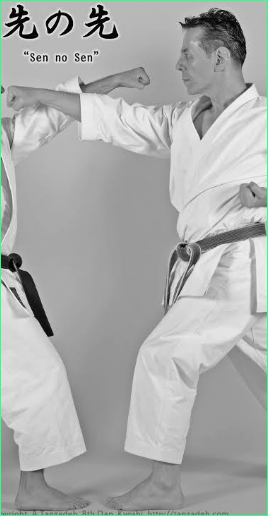
When the opponent starts their intention to attack, our response must come as quickly as possible. Anticipation is needed to make this happen. It can be strategic, like making your opponent act how you’ve planned, which needs a high level of skill in fighting. Or through understanding, figuring out what action the opponent will take. Or by instinct, which involves connecting with oneself and the opponent. By contrast, Sen-no-sen the moment the opponent’s intention becomes clear, the counterattack happens at the same time as the attack. For example, the opponent steps forward to attack and the counterattack occurs even before the opponent completes their technique. Tai-no-sen simultaneously creates a counterattack. For example, when the opponent steps and throws a direct hit, the counterattack is done at the same time while moving out of the way of the attack. Therefore, a Tai-no-sen is a Sen-no-sen, but a Sen-no-sen is not necessarily a Tai-no-sen.
Go-no-sen 後の先 and machi no sen To reply to an intention/attack after its start.
When the other person makes their move and you are in response mode blocking a strike and striking back. This can mean stepping back to then advance, a block and counterstrike, etc. In the case of machi no sen, we either took in the blow or they managed to seize us and we went along with a counterattack. This situation is very common in self-defense, where we are startled by a sudden moment and have to respond, but the other is one step ahead (both literally and metaphorically!)
In summary, in my view, one of the hardest states to achieve in order to reach the mitsu no sen which is additional is the concept of Shingan (Eyes of the heart/mind). This idea was taught to me by Jean-Noël Blanchette (9th dan, Hanshi) who shows this with his back turned to his opponent, eyes closed and fingers in his ears to block out his senses. Then the attacker picks the best moment to strike strongly and the practitioner must perform an ushiro geri to stop them. So this added effort requires sensing the “ki” (energy) of the attacker.
Now that we understand the concept, you still need to practice everything 10,000 times to gain the related skill and hope to one day show others that you understand and master this idea.
Conclusion
Understanding time is one of the most profound lessons that martial arts can teach. While we often divide our lives into the past, the present, and the future, these concepts become much more tangible through practice. The principles of Sen-no-sen, Tai-no-sen, and Go-no-sen illustrate that every action exists within a continuous flow of time, where perception, timing, and decision-making are inseparable. They remind practitioners that success is determined not only by technique but also by the ability to recognize the right moment to act.
The past, for example, is not a distant memory but something that exists only an instant behind us. The moment you finish reading a sentence, it has already become part of the past. Likewise, the future is not a remote destination but the next instant that has not yet arrived. Between these two lies the present—a fleeting moment that cannot be held or repeated. Martial arts training develops the awareness necessary to fully experience this present moment, where every movement, breath, and decision has immediate consequences.
The concepts of Sen-no-sen, Tai-no-sen, and Go-no-sen provide practical ways of understanding this relationship with time. Whether acting before an opponent’s attack is fully developed, responding simultaneously, or countering after the attack has been committed, each approach demands complete awareness of the present. A practitioner who hesitates becomes trapped in the past, while one who anticipates recklessly risks acting on a future that has not yet unfolded. True mastery lies in recognizing reality exactly as it exists and responding with clarity and precision.
latest posts published
What does the name of our dojo “ishin denshin” mean?

Water: the elixir of life and the secret to optimal hydration
Sempai, Kohai and Dohai: respect for the hierarchical system
What is a dojo (道場)? | At the origins of the word
Mitsu no sen (three points) les trois principals initiatives

Karate Belts: Understanding the Order of Ranks
The concept of “Giri”, a profound moral commitment
Kyokun Martial – In karate there is no first attack.
The social economy at the heart of our martial arts center
