
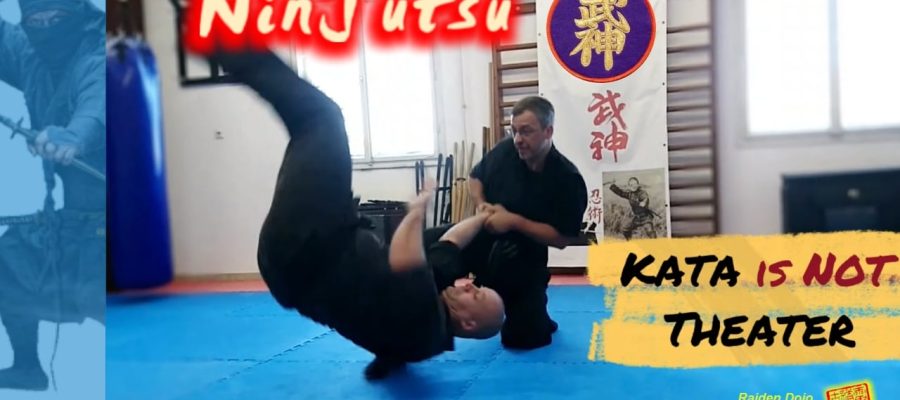
The term Kata, central to Japanese culture, refers to the form, the predefined pattern, and is confused by many as something rigid and inflexible. On the contrary, the concept is dynamic, multi-layered and is never used alone. But for this you need a guide, a master who can guide you through the complex concept of Shu-Ha-Ri for example, where a Kata undergoes so many changes.
Kata is used in classical martial arts in two forms:
– as Embu/demonstration, dedicated in the past to deities during spiritual events in Shinto temples. These demonstrations have now mostly turned into methods of more or less aggressive advertising, and also to boost the ego. How different classical demonstrations were from Western martial arts… (A topic for another post)
As a form of training, Kata must not be a theater, or simply a dry convention where one always wins and the opponent falls or gives up on his own or throws himself to the ground just because it is written in the school text. There are things that cannot be written, described or understood, like that» Waza or Nusumu» – steal the technique or the craft as we say. Of course, in Kata there is a conventional part, but there is always the element of free practice, there must always be an element of surprise, which raises the pulse and revives these old techniques! The attacker must do his job correctly and honestly and without hurting his partner, free in turn to attack when he wants. Uke, the one who defends, must be able to avoid the attack first, without creating problems to technique and earn. This is where true self-defense lies. And, of course, Uke may be affected because he can’t do it well at first, but everything will take shape and meaning step by step. The practice must be developed with Danger and Fear in mind and this does not mean using force or hurting anyone.
Kata: The Dynamic Blueprint of Mastery
The term Kata (型), central to Japanese culture, refers to the form, the predefined pattern, and is often confused by many as something rigid and inflexible. On the contrary, the concept is dynamic, multi-layered, and is never used alone. It is the comprehensive blueprint that contains the entire philosophy, technique, and strategic wisdom of a martial art.
A Kata is a sequence of movements designed to simulate combat scenarios against multiple opponents, but its purpose is less about choreography and more about internalizing principles. By practicing the Kata repeatedly, the practitioner develops:
-
Body Memory: In a real confrontation, the practitioner does not have time to think; the body must react. The Kata instills reflexive, correct responses (Hansei) through thousands of repetitions.
-
Transitional Mastery: It teaches fluid transitions between stances, blocks, and attacks, ensuring balance (Heijōshin) and structural integrity are never lost.
-
Bunkai (Application): The forms are encoded textbooks. Every movement in the Kata has multiple practical applications (Bunkai) against an opponent, and the study of the Kata involves decoding these hidden techniques.
But for this journey to be successful, you need a guide, a master who can lead you through the complex concept of Shu-Ha-Ri, for example, where a Kata undergoes so many changes in the practitioner’s understanding.
🔄 The Three Stages of Shu-Ha-Ri
Shu-Ha-Ri is a learning framework that perfectly describes the relationship between the student and the Kata:
-
Shu (Obey/Protect): This is the stage of strict adherence. The student meticulously follows the master’s instruction and the form of the Kata exactly as it is taught. There is no deviation or questioning. The student’s goal is to absorb the fundamental structure, timing, and footwork. The Kata is rigidly fixed, but this rigidity is necessary for building a true foundation.
-
Ha (Separate/Break): Once the student has fully internalized the form (Shu), they begin to experiment and understand the exceptions. They start to analyze the Bunkai deeper, adapting the Kata’s movements to different body types and situations. The student breaks away from strict adherence to explore principles, realizing that the Kata can be performed faster, slower, or with slight variations while maintaining its core essence.
-
Ri (Transcend/Leave): This is the stage of mastery. The student has fully absorbed the principles of the Kata and the style itself. The techniques are now seamless and intuitive. The student no longer performs the Kata as a sequence of prescribed movements, but as a natural, fluid expression of the underlying principles. The Kata becomes a dynamic, personalized movement that is no longer consciously reliant on the original fixed form.
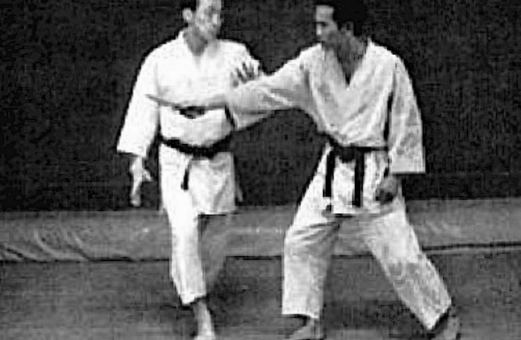
I remember Ishizuka sensei with his way of giving»Happy Pain» and mostly relaxed, laughing without any malice. There was the pure joy of transmitting the right amount of pain but above all a lot, a lot of care! And this is already a practice in itself, a first layer. Then the sensei can reveal other layers of the technique, because a Kata hides many layers: holds that transform into strikes, steps that evolve into hidden kicks, projections that in reality can be breaks and dislocations (koppo) and many others it does not depend on the kata, but on the depth of those who teach it. A process where you can actually recognize the style of a particular teacher, which makes the process of transmission (伝 den) even more powerful/authentic.
I arrived in Japan in search of «effective» and perhaps «secret» techniques and I discovered, after many years/travels, only Masters and People who opened my Heart, true and sincere examples of «Kokoro no Budo» – martial arts practiced with the Heart, of compassionate conscience»Jihi no Kokoro“Thanks again to those who guided my steps on this wonderful journey – Hatsumi sensei, Ishizuka sensei, Dr. Kacem Zoughari AND, Master Shimazu by Yagyu Shingan Ryu e Machida Kenshinsai sensei at the Enbukan Dojo (Takeda Ryu aikijutsu, Enshin Itto Ryu batto jutsu) If you find it interesting, we look forward to welcoming you to Raiden Dojo Bucharest to discover the wonderful and complex world of classical martial arts – Aikijutsu, Ninjutsu, Iai and Kenjutsualso domestic arts such as Taijiquan and Qigongtaught by experts surrounded by extraordinary people, ready to learn. Nothing competitive, just practice of personal, integral, somatic, mental and spiritual development, always in harmony with the principles of our arts learned directly from the source.
- Rog, Cristiano Ronaldo
- Raiden Dojo Bucharest
- marti/vineri 8.30pm – 10pm Ninjutsu and Aikijutsu
- Friday 7pm – 8.30pm Taiji and Qigong
- sambata 10 – 12.30 Iaijutsu and Kenjutsu
- The Judo Hall has lic. M Eliade, The Splaiul of Independence, 315-317
- The first session is free!:
latest posts published
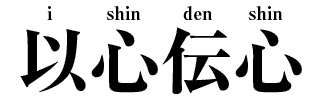
What does the name of our dojo “ishin denshin” mean?

Water: the elixir of life and the secret to optimal hydration
Sempai, Kohai and Dohai: respect for the hierarchical system
What is a dojo (道場)? | At the origins of the word
Mitsu no sen (three points) les trois principals initiatives

Karate Belts: Understanding the Order of Ranks
The concept of “Giri”, a profound moral commitment
Kyokun Martial – In karate there is no first attack.
The social economy at the heart of our martial arts center
