
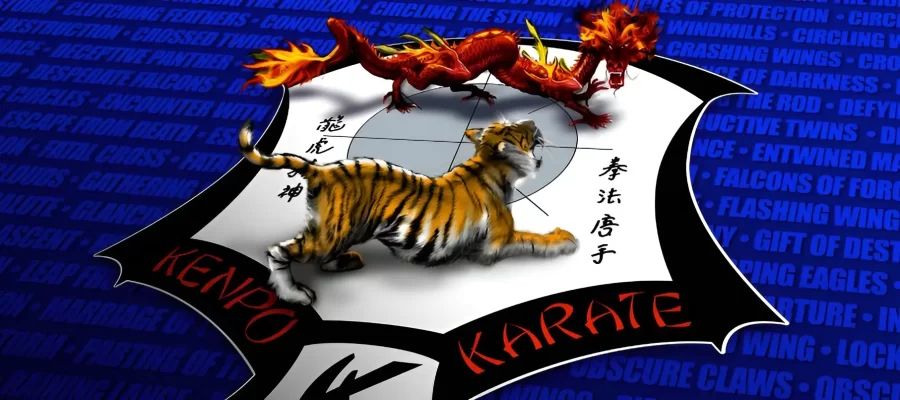
This emblem was created in 1960 by Ed Parker and designed by Dick and David Tercell to serve as the symbol of the newly formed International Kenpo Karate Association (created to replace the Kenpo Karate Association of America due to Kenpo’s expansion throughout the world). Even though today there are hundreds of different associations, each of which adopts its own coat of arms, the one created by Ed Parker will always be remembered as the true symbol of Kenpo.
–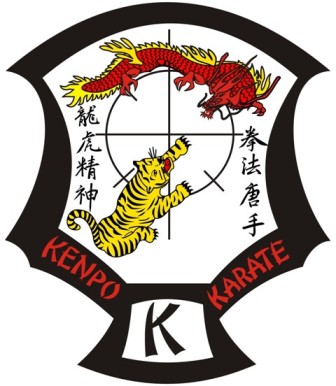
The Tiger:
It represents the earthly and material strength that is obtained during the first five stages of learning. In this phase the student is struck by the discovery of his own physical abilities, strength and power.
The Dragon:
It represents the spiritual force that accompanies the learning process. This spiritual stage is reached after many years of discipline and training. It is above the land force (as can be seen in the coat of arms). In this learning phase, the individual has achieved humility, self-control and self-confidence. The Dragon attitude is the highest in learning Kenpo. By having this posture, the individual will not be afraid of his opponent, will be aware of the damage he could cause in combat, will avoid conflicts and will be confident, since he knows that he will be victorious in a fight.
The Circle:
It represents life as it is, a continuous cycle with no end or beginning. Such is the art of Kenpo, an endless cycle of perpetual movements. Techniques are cycles and movements are parts of the cycle, courage, physical strength, spiritual strength and humility are just components of progressive learning. All movements evolve from a circle, both defensive and offensive. The circle represents the union between Kenpo practitioners, which must be continuous and infinite. The circle is the basis of the Kenpo alphabet, from which all movements originate.
–The dividing lines:
They represent the eighteen original movements of the hands, which determine the directions in which they can move. The attack or defense angles that can be used by you or your opponent. The lines of movement that can be covered by the feet.
–As core:
The circle is grey, it represents the brain (grey matter), thought.
OR Pack represents the large number of beginners, who form the foundation of the art.
OR Yellow and Orange represent the first levels of learning – the mechanical phase – the most dangerous of his learning, as he is impressed by his (tiger) physique and believes he has all the answers.
OR Brown It is the color of the tiger’s eyes and represents advanced students and how few their numbers are compared to beginners. At this level the student is more attentive. His eyes are like those of a tiger, cautious, inquiring, always seeking higher levels of improvement and competence and preparing for the day when he wears the sash of master.
OR Red represents all masters above black belts; but as the colors of the dragon indicate, traces of it still remain Pack in the eyes, Yellow AND Orange in the fins, Brown in your irises and Therefore in your students. This is to remind all teachers that they must always be HUMBLE and able to return to any level, whatever it may be, and carry out any action that is expected of others at that same level, with the aim of never expecting too much from their students.
–Eastern script:
It is a tribute to the fathers of our art: the Chinese. The symbols on the right mean: “Law of the Fist” (Kenpo) and empty hands (Karate). This is our art. The symbols on the left mean . “Dragon and Tiger Spirit” is a constant warning that our goal is to reach a high spiritual level and that the physical level is only a path towards this goal.
–One Form:
The upper part of the coat of arms is in the shape of a roof which offers shelter to all members of the association. The sides are concave, similar to those of a Buddhist temple, granting spiritual protection and wisdom to all those inside. The lower part is shaped like an axe. It represents justice. If at any time a member is influenced by evil ideas, attitudes or thoughts that are contrary to the Kenpo philosophy and brings shame to the organization, he or she will be separated from the association and will never be accepted back.
latest posts published
What does the name of our dojo “ishin denshin” mean?

Water: the elixir of life and the secret to optimal hydration
Sempai, Kohai and Dohai: respect for the hierarchical system
What is a dojo (道場)? | At the origins of the word
Mitsu no sen (three points) les trois principals initiatives
Karate Belts: Understanding the Order of Ranks
The concept of “Giri”, a profound moral commitment
Kyokun Martial – In karate there is no first attack.
The social economy at the heart of our martial arts center
