
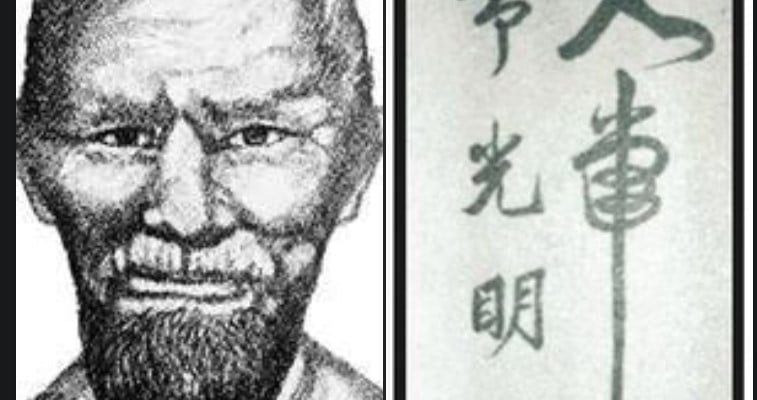
Longer post on Matsumura Sokontriggered by his beautiful calligraphy about modesty and calm:
“A truly modest person will always have inner calm “
-motto personal motto to him Matsumura Sokon Matsumura Sokon – cheie figure in Okinawan karate-ul.
(Japanese Hito tsuneni keikyo narebu sunawatchi kokoro wa tsuneni koumyo nari)
– Sokon’s handwriting at the age of 76 [1885] )
Pick up later Patrick McCarthyto whom we thank for the translation and efforts to promote karate in Ryukyu!
Matsumura Sokon
he is a figure of great importance in the evolution of Ryukyu Kenpo towards modern karate. His father was of Chinese descent, a descendant of one of the 36 families brought from China to the Ryukyu Archipelago. Matsumura he was practically a member of the Okinawan noble class, which further disproves the myth that Ryukyu martial arts belonged to local farmers who defended themselves with improvised weapons. Matsumura was also a good connoisseur of Chinese culture and equally expert in weapons and empty-handed techniques.
In 1828 he was sent on a diplomatic mission to China because he had already held the position of official bodyguard instructor (ShinanYaku) for 3 generations of Okinawan kings. From here arise some legends related to his training in Shaolin, historically unproven. But it is clear that by having this official position, he was able to meet many authentic Chinese experts in their martial practice.
Then, more importantly, he was sent to Japan, between 1832 and 1837, where he learned the famous Jigen Ryu sword of the Satsuma clan (which had initially occupied Ryukyu). Hokama-sensei He told me that Matsumura appears to be the only Okinawan who knew Kenjutsu and even taught it in Japan at one point. (to Ankō Asato and Itarashiki Chochu).
Longer posts about Matsumura Sokon
Hence come the comparisons with Japanese sword technique, names like Tegata or Shuto) And it makes a lot of sense to make these comparisons after having practiced the sword enough (and it seems he had the maximum level on the sword – Menkyokaiden in Jigen Ryu).
Otherwise the comparison with the sword is unfounded: it is easy to say hitting with Shuto as if cutting with a sword! But what, when was the last time you cut with a sword, and cut properly? (And with the sword there is a lot of work until the right thing comes out) The same thing happens with disciplines that are truncated and deprived of an important part of their original practice. Similarly, in Baduanjin Qigong we have the «Arching» form and it is not at all easy to shoot the bow and still hit if possible.
Or in modern Aikido where the sword is extremely limited as a technical form, it is too easily said that technique X is «like a sword»  Serious? Like which sword, which style more exactly? I think it should be like what he practices Ueshiba OR Sogaku-sensei (and even here the style doesn’t even help, because each teacher can teach the same style in a different way… and what he teaches can be received differently by each of the students…) But at least we can understand how important direct transmission is in learning something.
So we can understand the practice of traditional Kenpo as a source of modern karate a little better by understanding Jigen Ryu Kenjutsu. Maybe that’s why he introduced me Machida-sensei and techniques Jigen Ryu in practice – to better understand the practice of Karate and perhaps this is why dance has also tried to get closer to this school (naturally with some reservations).
Thank you for your patience in retracing these lines and remembering some of the masters thanks to whom we can now practice various disciplines through which we can rediscover ourselves. Returning to the source, I think, must always be part of our practice, which limits the ego and mental wanderings. And yes, that deep inner calm that seems to be so hard to achieve for some… and especially in today’s society.
PS And perhaps that calm and state of modesty seem a little difficult to associate with martial practice, karate in this case. Yet it is very possible if we do not limit ourselves to external practice. Let’s not forget that in Matsumura’s time the sport of kumite did not yet exist and there was no talk of competitions. It was a military practice reserved for an elite class who carried it out professionally.
And the emphasis on Kata as a form of education and training barely seems to appear Matsumura (Mertz, 2017) – it is therefore a sort of “innovation” of his.
And this means that until then the practice of the forms (Kata) was not necessarily in the foreground. The emphasis on form was introduced by Matsumura after his visit to China, as group teaching methodology, group education. Returning to internal practice, it is sufficient to have the right intention in training (and here the role of the instructor must be underlined) and then work correctly on grounding/posture/abdominal breathing and certainly, wanting to overcome the conflict to enjoy harmony and life at your own pace.
latest posts published
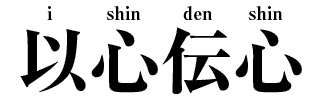
What does the name of our dojo “ishin denshin” mean?

Water: the elixir of life and the secret to optimal hydration
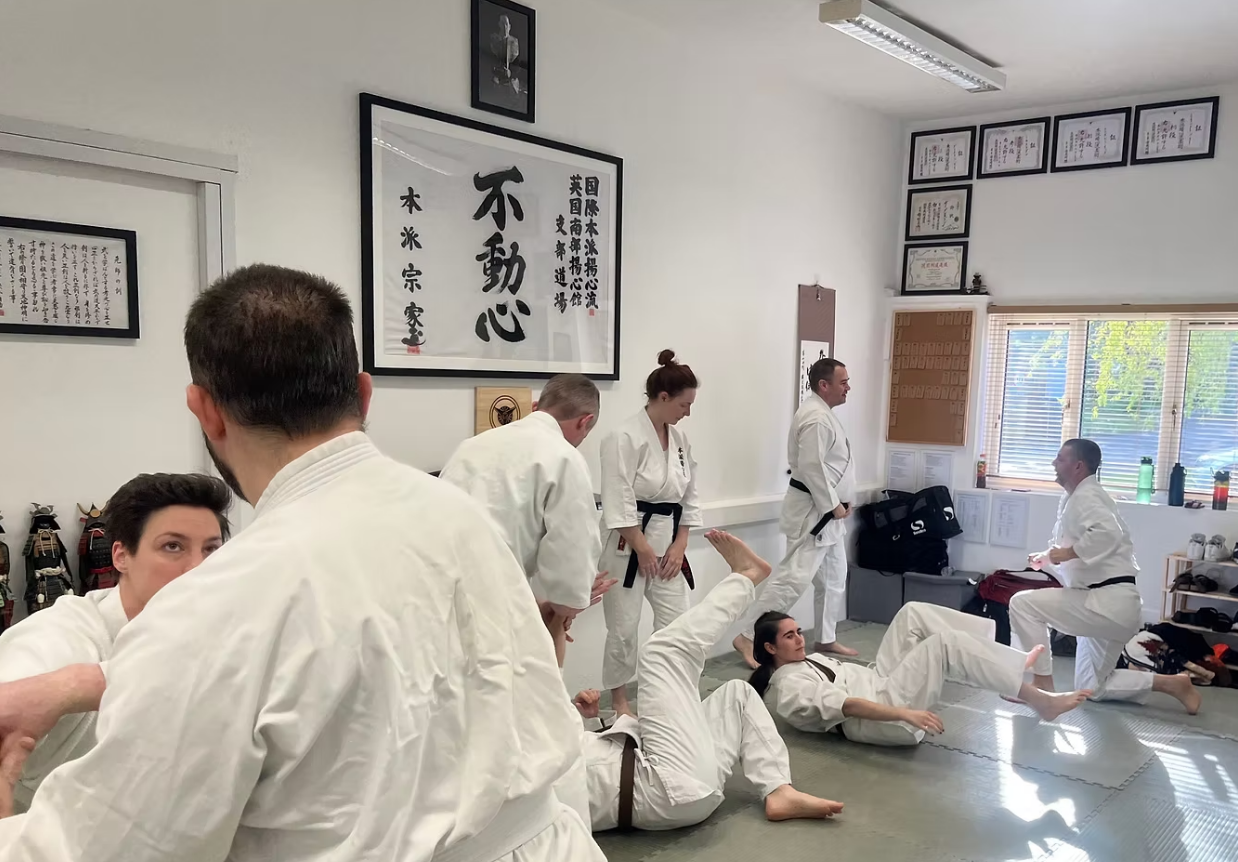
Sempai, Kohai and Dohai: respect for the hierarchical system
What is a dojo (道場)? | At the origins of the word
Mitsu no sen (three points) les trois principals initiatives
Karate Belts: Understanding the Order of Ranks
The concept of “Giri”, a profound moral commitment
Kyokun Martial – In karate there is no first attack.
The social economy at the heart of our martial arts center
