
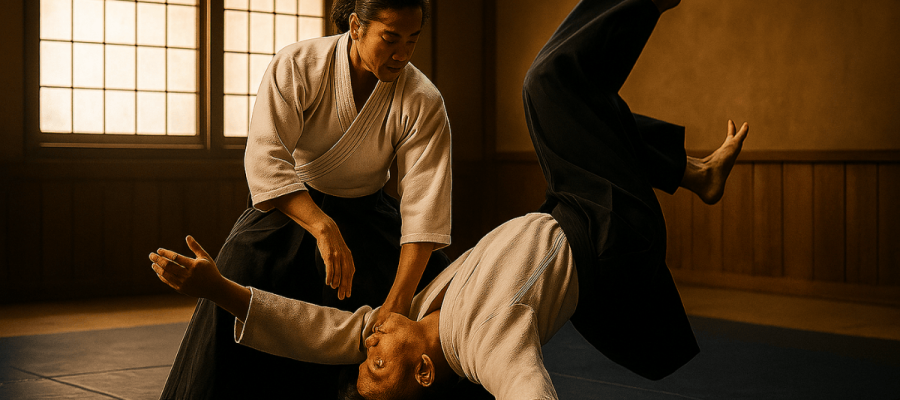
Discover the importance of Ukemi in Aikido: the art of falling with awareness. Understand how this practice goes beyond the mat, teaching resilience, balance, and wisdom for life. In Aikido, one of the first skills taught is not how to take down an opponent, but how to do it how to fall correctly. This learning is known as Ukemi — the art of falling safely. Far beyond a physical technique, Ukemi carries with it a philosophy of resilience, adaptation and humility. In this article we will explore why learning to fall is so vital in the practice of Aikido and how this lesson extends to everyday life, preparing us to face challenges with balance and awareness.
What is Ukemi?
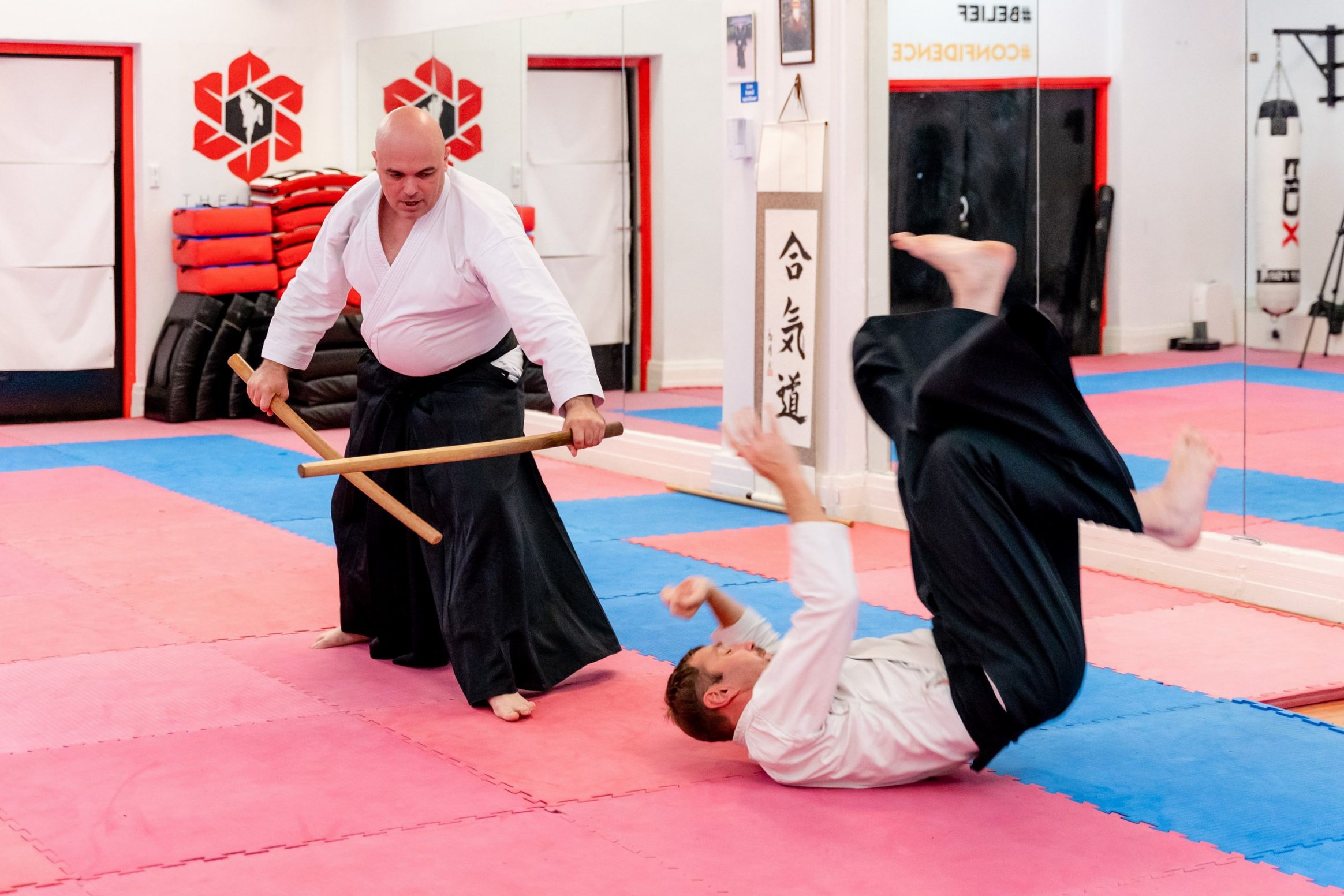
Ukemi (passive) can be literally translated as “receiving with the body”. In the practice of Aikido, this refers to the techniques of rolling, cushioning falls, and fluid movement to minimize impact. Learning Ukemi does not mean surrendering to the attack, but rather learning to protect yourself, maintaining physical and mental integrity.
Ukemi is a clear manifestation of the principle of not resistanceone of the pillars of Aikido. The practitioner adapts to the partner’s movement, absorbs the energy and transforms the situation into safety.
Ukemi philosophy: learning to fall to get back up
Ukemi’s philosophy goes beyond the mat. Learning to fall means understanding that:
- Falling is part of the journey.
- Falling is not a failure, but a learning.
- Lifting with awareness is a sign of inner strength.
In the dojo every fall is an opportunity for technical and emotional growth. In life, every stumble can be seen as an opportunity to reevaluate the path and move forward with greater wisdom.
Benefits of Ukemi for the body and mind
1. Accident prevention
Continuous rolling and falling training develops motor coordination, reflexes and body awareness, dramatically reducing the risk of injury, both in the dojo and in everyday situations, such as accidental falls.
2. Emotional control
Learning to fall calmly helps the practitioner develop self-control, accepting adverse situations without panic. It is a constant exercise in presence and emotional balance.
3. Humility and mental flexibility
In Ukemi there is no room for the ego. It teaches us that there is no shame in falling: the real merit lies in getting up consciously. This forms a more humble and receptive practitioner to continuous learning.
Ukemi and a Practitioner’s Day
Many beginners encounter resistance when they begin practicing Ukemi. Fear of getting hurt, discomfort with new things, and insecurity are natural. Over time, however, the professional develops Trust, courage And resilience.
Ukemi is a living metaphor for the Aikido journey: it’s not about winning, it’s about winning learn from every experienceadapt, fall and get back up with dignity.
Ukemi na Vida Real
How many times in our lives do we see ourselves «falling»? Whether it’s a professional mistake, a personal disappointment, or an unexpected obstacle, we all face difficult times. Ukemi prepares us – symbolically and physically – for these moments.
It teaches us to:
- Dampen the emotional impact;
- Don’t blindly resist changes;
- Return to balance with serenity.
Discovering the Importance of Ukemi in Aikido: The Art of Falling with Awareness
In Aikido, one of the first skills taught is not how to take down an opponent, but how to fall correctly. This learning is known as Ukemi (受け身) — the art of receiving or falling safely. Far beyond a physical technique, Ukemi carries with it a profound philosophy of resilience, adaptation, and humility. It is the vital counter-balance to the throwing or joint-locking techniques of Aikido.
We will explore why learning to fall is so crucial in the practice of Aikido and how this lesson extends to everyday life, preparing us to face challenges with balance and awareness.
🛡️ The Physical Necessity of Ukemi
The necessity of Ukemi is first and foremost physical. Aikido involves a wide array of circular throws (Nage) and sweeps that lift and propel the body with significant force. If a practitioner cannot safely receive these techniques, training becomes impossible and dangerous.
-
Injury Prevention: Ukemi teaches the student how to distribute impact across larger surface areas of the body through rolling (Zempo Kaiten) or breaking the fall with a slap (Ukemi Waza). This ability to absorb and dissipate force protects the joints, head, and spine, ensuring the longevity of a practitioner’s training career.
-
Relaxation and Flexibility: Paradoxically, executing Ukemi requires the body to be relaxed. If the body is tense or rigid, the impact is absorbed directly and is more likely to cause injury. Practitioners learn to «let go» and move fluidly with the force, making them both physically safer and more pliable during techniques.
🧠 The Philosophical Dimensions of Ukemi
The true significance of Ukemi lies in its mental and philosophical components, which directly embody the spirit of Budō:
-
Resilience and Recovery: Ukemi is the physical manifestation of resilience. The fall is inevitable; the lesson is in the recovery. It teaches the practitioner that being taken down is not failure, but merely a necessary transition. The immediate return to a stable, ready position demonstrates the mental fortitude to quickly recover from a setback.
-
Adaptation and Non-Resistance: The best Ukemi is achieved when the receiver does not resist the force but blends and harmonizes with the thrower’s technique. This practice of «giving in» to the opponent’s momentum teaches a core Aikido principle: adaptation over rigid resistance. It transforms confrontation into a cooperative movement.
-
Humility and Trust: To execute Ukemi properly, the Uke (the one receiving the technique) must place complete trust in the Nage (the one applying the technique). This act of trust requires a profound sense of humility, acknowledging one’s vulnerability and depending on the skill and care of the partner.
Conclusion: a practice that goes beyond the Tatami
Ukemi is much more than technique. It’s philosophy, it’s life practice. In Aikido we learn that falling is natural, but getting up with dignity is essential. Developing this skill not only improves performance in the dojo, but strengthens character, shapes the mind, and inspires a more conscious and resilient attitude towards life.
If you are looking for a martial art that goes beyond combat and promotes true personal growth, Come and try an Aikido lesson in our dojo. Here you will learn to fall with awareness and rise with purpose.
latest posts published
What does the name of our dojo “ishin denshin” mean?

Water: the elixir of life and the secret to optimal hydration
Sempai, Kohai and Dohai: respect for the hierarchical system
What is a dojo (道場)? | At the origins of the word
Mitsu no sen (three points) les trois principals initiatives

Karate Belts: Understanding the Order of Ranks
The concept of “Giri”, a profound moral commitment
Kyokun Martial – In karate there is no first attack.
The social economy at the heart of our martial arts center
