
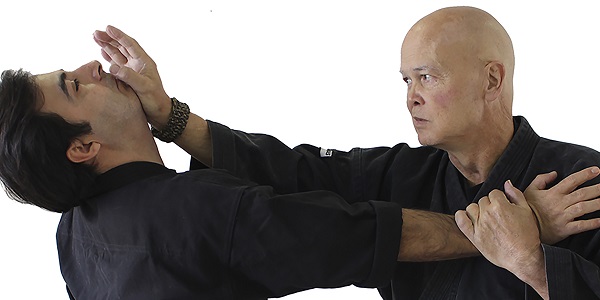
Richard “Huk” Planas began his training in the city of Fresno – California, in the early 1960s under the guidance of Steve Labounty and Tom Kelly. In 1969 he moved to Texas to help Tom Kelly open a school in El Paso and then to Pasadena – California, to begin working directly with Ed Parker, still a brown belt.
–Richard “Huk” Planas Biography – Kenpo Karate
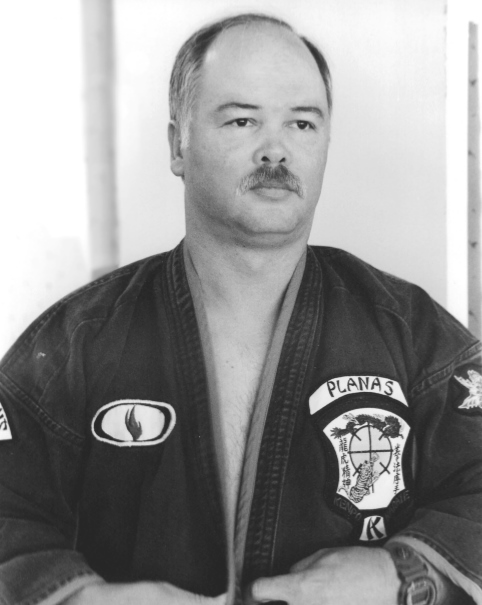
He received his black belt and all other degrees up to 7th dan (in 1985) from Parker himself. It is the highest political or non-honorary title awarded by Ed Parker to a student. He became a Pasadena school administrator for several years and vice president of the IKKA for the last 10 years of Parker’s life.
Soon after Parker’s death, several Kenpo associations were formed, one of which promoted Planas to 8th dan in 1991 and, in 1995, several federations joined together to raise him to 9th dan. Although his greatest expertise is in Kenpo, he has studied many other martial arts such as Judo, Tai Chi, Kung Fu, Shotokan Karate, Silat, and Philippine Martial Arts.
Mestre Planas was the subject of an article in Black Belt magazine in January 1992, titled «Who is the rightful heir to Ed Parker’s Kenpo?» And again with the same theme in 1997 in Kenpo Rules of Motion. He collaborated with Ed Parker on two of his books, Infinite Insights Into Kenpo and Ed Parker’s Guide to the Nunchaku written in 1975.
“Huk” Planas teaches the “why” of Kenpo, and not just the “how”, always based on the rules and principles of the movement developed by Parker. It teaches the original system, as it was developed by Ed Parker, without the usual modifications made by other instructors and associations.
His seminars draw large crowds from around the world, as well as countless instructors who seek him out for private lessons and intensive training in New Orleans.
–
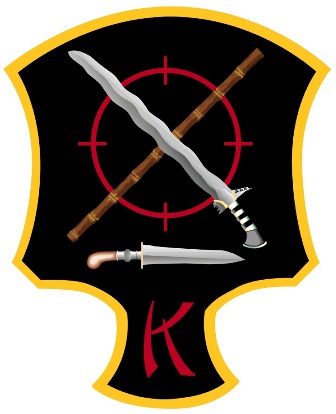
The meaning of the coat of arms
Sensei Planas’s crest has the same basic shape as Ed Parker’s, but has been modified so that its shape more closely resembles that of a shield.
– The black within the crest symbolizes the death of Ed Parker and the gold the ascension of his spirit.
– The letter K in red represents both Kenpo and Kali, also representing Planas’ Filipino blood heritage with its color.
– The weapons form a triangle, once again to symbolize the Filipino side of the art. The triangle is not closed, so knowledge can enter at any time.
– The circle is red, once again to represent the lineage of my students.
– The X and + angles have been changed from Parker’s crest to emphasize the angles most used in Kenpo.
– The blades are silver to symbolize Yin and Yang, and also to symbolize the 25th year of the planes within Kenpo; the year the coat of arms was created.
Conclusion
Mestre Planas stands as a pivotal figure in the lineage of Ed Parker’s Kenpo, embodying both mastery and fidelity to the original system. Having earned his black belt and successive degrees up to 7th dan directly from Parker, Planas represents one of the few students recognized with the highest non-honorary title by the Kenpo founder himself. His deep understanding of Kenpo is complemented by decades of administrative experience, including serving as Pasadena school administrator and vice president of the IKKA during Parker’s lifetime, cementing his influence both as a practitioner and as a custodian of the art.
Following Parker’s passing, Planas’s authority and dedication to the authentic Kenpo curriculum were further recognized by multiple associations, ultimately awarding him the 9th dan. His expertise, while rooted in Kenpo, is enriched by extensive study in other martial arts—including Judo, Tai Chi, Kung Fu, Shotokan Karate, Silat, and Philippine Martial Arts—providing him with a broad understanding of movement, strategy, and martial principles. This diverse background allows him to teach the “why” behind Kenpo techniques, emphasizing the underlying principles rather than rote execution, a methodology faithful to Parker’s original vision.
Planas’s contributions to the art are also documented through his collaboration with Parker on seminal works like Infinite Insights Into Kenpo and Ed Parker’s Guide to the Nunchaku. These publications, along with the articles in Black Belt magazine exploring the question of Parker’s rightful heir, reflect his recognized authority and enduring legacy in the martial arts community.
Today, Planas continues to draw students and instructors from around the globe to his seminars in New Orleans, where his teaching focuses on preserving the original Kenpo system, free from the common modifications introduced by other lineages. His work exemplifies the integration of skill, knowledge, and fidelity to tradition, demonstrating that true mastery involves both understanding the mechanics of movement and honoring the principles and philosophy established by the founder.
latest posts published

What does the name of our dojo “ishin denshin” mean?

Water: the elixir of life and the secret to optimal hydration
Sempai, Kohai and Dohai: respect for the hierarchical system
What is a dojo (道場)? | At the origins of the word
Mitsu no sen (three points) les trois principals initiatives

Karate Belts: Understanding the Order of Ranks
The concept of “Giri”, a profound moral commitment

Kyokun Martial – In karate there is no first attack.

The social economy at the heart of our martial arts center
