

The best way to put the 10 Laws of Kenpo into practice is to consider them as keys capable of unlocking higher levels of knowledge. It is important to remember that nothing is set in stone, as there are always exceptions to every rule.
1 – Circle and line
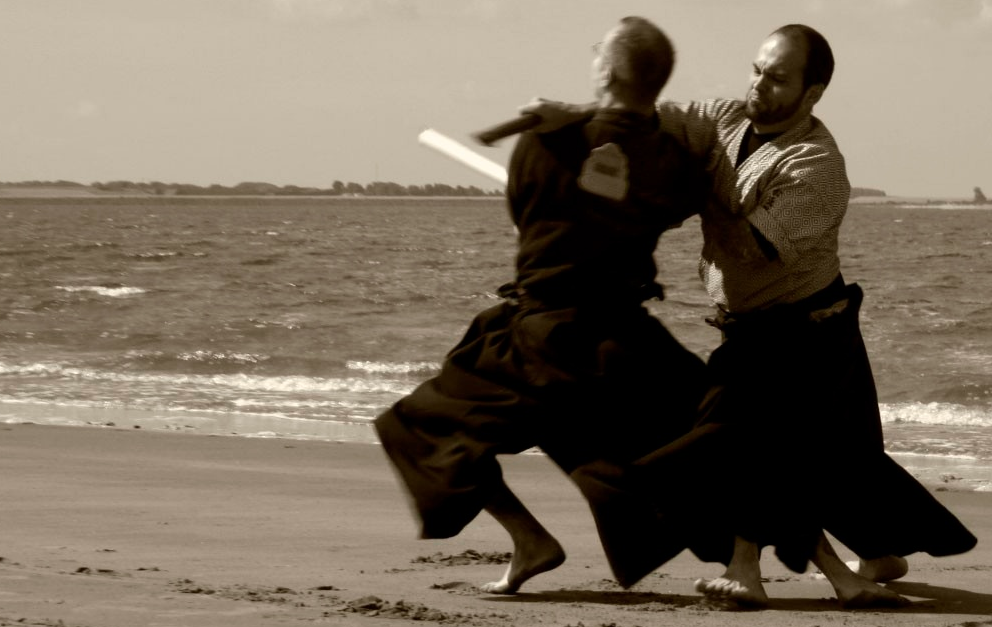
The first law of Kenpo teaches that when your opponent attacks by advancing in a straight line, you must use your feet and move your body in a circular trajectory, moving your arms circularly to repel the attacker’s force. When your opponent attacks you in a circular pattern, you must quickly respond with a linear attack within the circular area defined by your opponent’s attack.
2 – First shot
This principle has several meanings. The first shows that Kenpo is primarily an art of traumatic strikes. “80% hands and 20% feet” is the classic method, but you can modify the techniques based on the circumstances of your body or physical shape.
The second meaning is that if the clash is inevitable you don’t have to wait for the aggressor to attack first. You have to attack him with your feet, fists, elbows, knees, etc. You have to hit the attacker hard and hit him continuously until he is defeated.
The Kenpo program also includes grappling and throwing techniques, but studies have shown that they are used in less than 25% of recorded assault cases. Furthermore, they are sometimes ineffective against multiple attackers. The grip has 4 times more strength and energy than traumatic strikes, but in Kenpo it is considered the last resort when your opponent overcomes the first and second lines of defense (hands and feet respectively).
3 – Multiple shots
Kenpo is different from many martial arts styles in that it teaches you to strike first and to strike fluidly in rapid succession: high, low, straight and circular. When you trigger a succession of rapid strikes, it becomes difficult to use the “Kiai” (scream) simultaneously with each strike. Therefore you must refrain from shouting with each blow. In reality, doing so means consuming excess energy. Yelling is useful for intimidating your opponent and putting them at an emotional disadvantage.
Your first and second hits should be applied to stun, distract, and slow your opponent. His third and, if necessary, fourth strikes are knockout strikes. Remember the Kenpo maxim: “First fix your opponent, then knock him out.”
4 – Objectives
No one has ever broken their knuckles hitting an attacker’s temples, no one has ever broken their feet kicking someone in the groin, and no one has ever suffered a knife wound hitting an attacker’s throat. In Japan, the Makiwara is used to work with the hands, in Thailand, Muay-Tai fighters tighten the skin by kicking handstands. Kenpo is different! Kenpo teaches the technique of least resistance and least pain. More precisely targeting the temples, eyes, nose, neck, floating ribs, solar plexus, groin and genitals. They are hard parts of our body that hit soft parts of the opponent’s body to produce greater damage with less effort.
5 – Falls
Kenpo teaches that low kicks are based on logic. A roundhouse kick or rotating reverse crescent at head height can be quick and unpredictable, but these movements take a long time to perform because the legs have a long way to go. Furthermore, they expose the groin to the attacker’s counterattacks. High kicks require superior balance and concentration. You should shoot high in training and low for self-defense.
6 – No blocking
Kenpo emphasizes economy of movement and saving time. The non-blocking principle teaches that to avoid being hit by a punch or kick, you need to move your body out of the path of the attack. The most advanced defense taught in martial arts is expressed in a Zen saying: «Avoid instead of dodging, dodge instead of blocking, block instead of hitting, hitting instead of wounding, wounding instead of maiming, maiming instead of killing, because for everyone, life is precious.»
Strategically, a block is a wasted move because it does not prevent the opponent from attacking again with free limbs. It’s best to stay out of his reach and counterattack him at the same time. However, this way of fighting is reserved for brown belts and above, because it requires a high level of skill to use correctly and a considerable amount of fighting experience to avoid the tendency to let the feet «stick» to the ground during the most tense moments of the fight.
The principle of non-blocking does not mean not blocking all combat movements. If you find yourself in a corner with no way out and someone attacks you, you will have to block their attack. This is why Kenpo teaches different blocking systems, which however lead to the same maxim: «the best blocking is no blocking».
7 – Surrender and redirect
Surrender and redirection are well represented by the Yin and Yang (soft and hard) symbol. When your opponent attacks hard, you must counterattack softly. If your opponent is weaker than you or your attacks are weak, you need to attack hard to end the fight quickly and directly. In most martial arts systems, blocks are extremely hard and can injure not only the attacker, but also the defender. Although Kenpo teaches that a block is also a strike, Kenpo also teaches how to block softly and how to strike hard.
Redirection is also critically important. Many martial arts teach practitioners to block downward to stop front kicks, resulting in a strong blow to the attacker’s instep to stop the kick. Such an impact could break the hand or arm of the person performing the block. Kenpo teaches that it is best to redirect the attacking leg away from your center of balance before counterattacking. Such a redirection move will be used to break the opponent’s balance and leave him vulnerable.
8 – Mobility
Mobility will be the easiest principle to understand. This means that a moving target is more difficult to hit than a stationary one. As trivial as it may seem, many martial artists fail to implement it. Kenpo teaches that there are three types of fighters: the statue, which has little mobility and does not retreat; the runner, who must be chased; and what is just waiting to fight back. If you fit one of these descriptions, it’s best to be careful as your movements are predictable and can be used against you. The Kenpo fighter must mix the three types, no matter how, and always keep moving. If your position is correct and your movements are good, you may be able to put yourself in a relatively superior position compared to your opponent.
9 – Flexibility
The law of flexibility is the law of survival. Kenpo is one of the few arts that adapts to your body, personality and spirit. If you’re 5-foot-5, there’s no point in focusing on kicking when your strengths might be mobility and quickness. If it’s a 45kg woman, it doesn’t make much sense to use forceps on a 100kg attacker. The ancient Kenpo masters demonstrated their wisdom when they proclaimed that in the struggle for life one must use what one knows best and forget what does not apply at the moment.
Each practitioner has different attributes and can make them effective. A tall person with long legs has an advantage with kicks, a short person has an advantage with punches, a heavy person has an advantage with grappling. The law of flexibility allows everyone to develop their own repertoire of techniques in Kenpo.
10 – Warrior Spirit
The final principle of Kenpo consists of two essential components: the Internal and the External. A rabid dog can pose a great threat, but it only possesses the external component of the warrior spirit. Inside the animal does not think. To be a complete warrior, you must be fierce on the outside but calm and peaceful on the inside.
Samurai warriors said that every day is a good day to die. This does not mean that they desired death. On the contrary, their goal was to preserve life. However, they discovered that only by embracing and accepting death could they focus everything on the physical level to defeat the enemy.
Your Kiais (screams), facial expressions, stances, guard positions all need to be worked in unison. Following the principle of Yin and Yang, you should be hard on the outside and soft on the inside. When used in this way, the warrior’s spirit can be more important than physical ability.
latest posts published
What does the name of our dojo “ishin denshin” mean?

Water: the elixir of life and the secret to optimal hydration
Sempai, Kohai and Dohai: respect for the hierarchical system
What is a dojo (道場)? | At the origins of the word
Mitsu no sen (three points) les trois principals initiatives

Karate Belts: Understanding the Order of Ranks
The concept of “Giri”, a profound moral commitment
Kyokun Martial – In karate there is no first attack.
The social economy at the heart of our martial arts center
