

These are among the most important concepts of Kenpo Karate. They evolve Kenpo as a martial art and as an art adaptable to anyone, regardless of physical type, age, weight or gender.
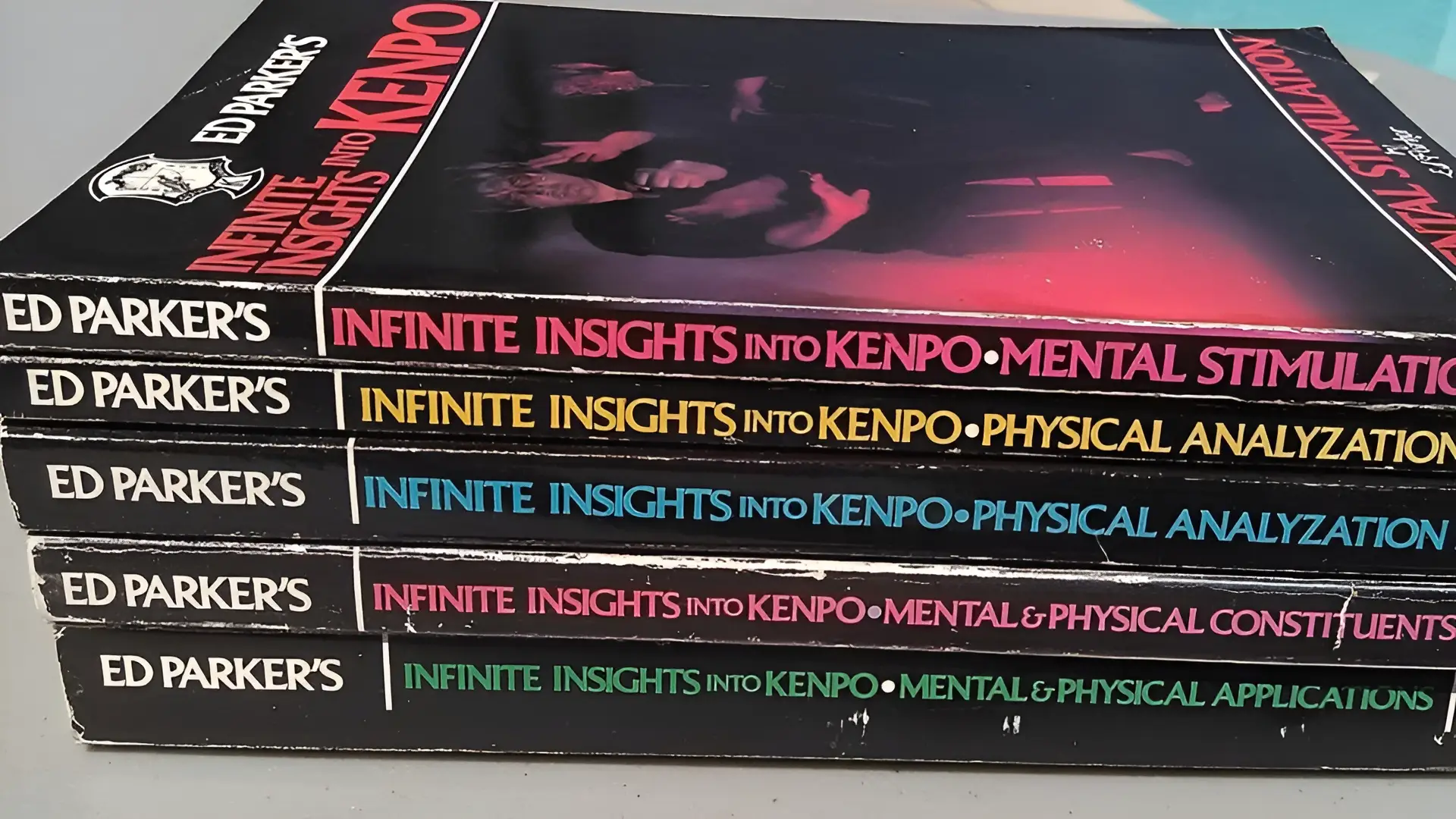
Learning and developing Kenpo techniques is very similar to learning to write words, develop sentences, paragraphs and compositions. Below are the definitions found in Grand Master Ed Parker’s “Encyclopedia of Kenpo”:
The three-phase concept:
The concept does not take any technique as a standard or rule in itself, but is still composed of Three Phases:
– Ideal: Phase 1
– What if: Phase 2
– Formulation: Phase 3
(Ed Parker’s Kenpo Encyclopedia – page 126)
The formula of the equation:
This is a formula that can be followed to develop specific, practical and logical fighting patterns. The formula provides conclusive foundations for working on alternative actions.
Whatever the basis, regardless of whether it is a single movement or a series of them, you can:
(1)Prefix: adds one or more movements before;
(2)Suffix: add one or more movements after;
(3)Insert: adds a movement simultaneously to the established sequence. This move can be used through:
(a) Pressure Control: Using pressure against an opponent’s weapons to nullify the action that would be taken by him, or
(b) Position control: position the hand or leg in a defensive position or angle to minimize entry into vital areas;
(4)Rearrange: change the sequence of movements,
(5)Edit:
(a) Weapon,
(b) Objective
(c) The weapon and the target
(6)Adjust:
(a) Alcance,
(b) Travel angle (affecting depth versus height),
(c) Both the execution and reaching angles:
(7)Normal or (a):
(a) Speed,
(b) Strength,
(c) Speed and force,
(d) Intent and speed.
(8) Delete: delete one or more movements from the sequence.
(Ed Parker’s Kenpo Encyclopedia – page 48)
Practical application of the concept
Phase 1 – (THE IDEAL PHASE) AN IDEAL PHASE
In this first phase of learning a technique, the instructor must provide the student with a fixed pattern of movements to defend himself from predetermined attacks.
This phase is designed to provide the student with the foundation on how to structure the movement and allow them to analyze the concept behind the technique through three points of view (the defender’s point of view, the attacker’s point of view and the point of view of an observer).
Kenpo beginners should be introduced to basic movements such as the outside knife hand strike, inside block, front kick and neutral stance.
The instructor should lead students to practice these movements and group them to form a self-defense sequence against a given attack.
For example, combining the movements listed above and structuring them to defend against a hold on the left side of the collar (GI), you will step back with your left foot and perform an inside block on the opponent’s forearm, followed by a front kick to the opponent’s genitals and finish with a blow with the knife of your hand on the side of the opponent’s neck (this movement pattern or technique is called Delayed Sword and is part of the yellow belt requirements).
Notice how the four basic movements have been structured into a technique (fixed pattern of movements) to defend against a certain attack. Something very similar happens in the early stages of learning to read and write.
When children enter primary school they are introduced to fixed patterns of letters and words to read, write and put into sentences. This gives them the basics on how to structure words and sentences to express an idea. Students are encouraged to read simple words such as E, A, BOLO and BALA and put them into a set sentence: THE CAKE AND THE BALA.
Notice how these simple words could be seen as the basic movements of Kenpo (e.g. retreat, inside block, outside hand knife, front kick, etc.) and structured into a sentence to express an idea that can be seen as a basic movement pattern or technique (Delayed Sword).
Phase 2 – “WHAT IF” phase
After the student has learned and perfected the basic technique in the Ideal Phase, it is time to explore the next phase, the What If?
At this point the instructor should begin asking the student questions such as:
What if you could change the weapons used in the knife technique from the outside hand to the backhand strike?
What if the attack had been different?
Can the same sequence of movements work against a different attack?
For example: can the delayed sword work against a straight punch with the right arm, a front kick with the right foot, a two-handed choke, etc.?
What if you could insert or eliminate a movement within a given succession of movements without interrupting the flow or the basic idea of the technique?
At this point we must begin to apply the Formula of the Equation.
As stated in the definition listed above, the equation formula allows the practitioner to add a prefix and suffix (add movements before or after a given technique), insert, delete, rearrange, or modify the natural weapons or targets used in a given technique to enhance or adapt the technique to one’s body type or specific preferences.
That is, the technique must always adapt to the practitioner and not the practitioner to the technique.
You can adopt techniques such as the Delayed Sword, which has a fixed pattern of movements: withdraw the left leg, internal block with the right arm, front kick, external strike with the knife in hand and start asking the student the following questions:
(a) What if he could defend himself from an attack other than a grab with his right arm on the collar of his clothes?
(b) What if you could prefix (add a move before the given technique) by applying a hammer to your opponent’s face before starting the technique?
(c) If so, you could SUFFIX (add a movement after the given technique). Add a left uppercut to the attacker’s face after completing the technique?
(d) If he could INSERT, DELETE, ALTER or REORGANIZE the movements within the technique without interrupting the flow of movement. For example, INSERT an inside elbow between the inside block and the front kick with the right leg; DELETE front kick; CHANGE to a knee or REORGANIZE the outside knife hand strike with the right leg front kick?
This is similar to learning to write complex sentences, paragraphs, and essays in high school. In high school we learned to use the IDEAL PHASE in sentences like ‘THE CAKE AND THE BULLET’ and the words Prefix, Suffix, Insert, Delete, Reorder and Change while keeping the same basic idea of the sentence.
Let’s take the Delayed Sword technique as an example and represent it in the prayer ‘THE CAKE AND THE BULLET’.
You can:
(A) Prefix: ‘LOOK AT THIS CAKE AND THIS BULLET’ –
(b) Suffix words: «THE CAKE AND THE BULLET ARE SIDES OF ANOTHER»
(c) Insert the words: «CHOCOLATE CAKE AND BANANA CANDY»
(d) Delete the words: «THE CAKE»
(e) Rearrange the words: «THE BULLET AND THE CAKE»
(f) Change the words: «THE FOOL AND THE BALL».
Notice how all the sentences keep the same basic idea, but the way they are executed is different.
PHASE 3 – THE FORMULATION PHASE
In this phase, the student must use what he thought during the WHAT IF phase? and apply to modify the Ideal Phase, improving or modifying the technique based on your physical type or preferences.
For example, you can take the Delayed Sword technique and apply any of the concepts within the «Equation Formula» (Prefix, Suffix, Insertion, Deletion, Rearrangement, or Alteration) and create your own customized version of the technique, while still maintaining the same basic idea as the «Ideal Phase».
These are examples of the Delayed Sword technique in the Ideal Phase formulated in a custom Delayed Sword and an Ideal Phrase formulated in a custom sentence:
Retarded Sword as it should be taught (Ideal Phrase – Ideal Retarded Sword) – Defense against the lapel hold:
(1) Step back with your left leg while performing an inside block with your right arm;
(2) Perform a front kick to your opponent’s genitals;
(3) Execute a sternum blow with the knife of your hand on the opponent’s neck with your right arm.
Personally formulated version of the Delayed Sword technique – defense against a right arm hook:
(1) Step back with your left leg while performing a right arm strike with the hammer hand on the opponent’s bicep (note: internal block for the purpose of striking, not just defending – Change of weapon and target) and simultaneously perform an external strike with the left hand knife on the opponent’s forearm (Insert).
(2) Perform a front kick to your opponent’s genitals (no exchange).
(3) Execute an external knife strike from your hand to the opponent’s neck followed by a reverse left punch to the opponent’s nose (“Suffix”).
The same concept could be used to formulate a sentence to talk about a cake and a sweet in a certain way and my way:
– Ideal sentence = The cake and the bullet.
– Personal phrase formulated = The chocolate cake (Insert) together (“Change”) with the candy are placed side by side (Suffix).
latest posts published
What does the name of our dojo “ishin denshin” mean?

Water: the elixir of life and the secret to optimal hydration
Sempai, Kohai and Dohai: respect for the hierarchical system
What is a dojo (道場)? | At the origins of the word
Mitsu no sen (three points) les trois principals initiatives
Karate Belts: Understanding the Order of Ranks
The concept of “Giri”, a profound moral commitment
Kyokun Martial – In karate there is no first attack.
The social economy at the heart of our martial arts center
