
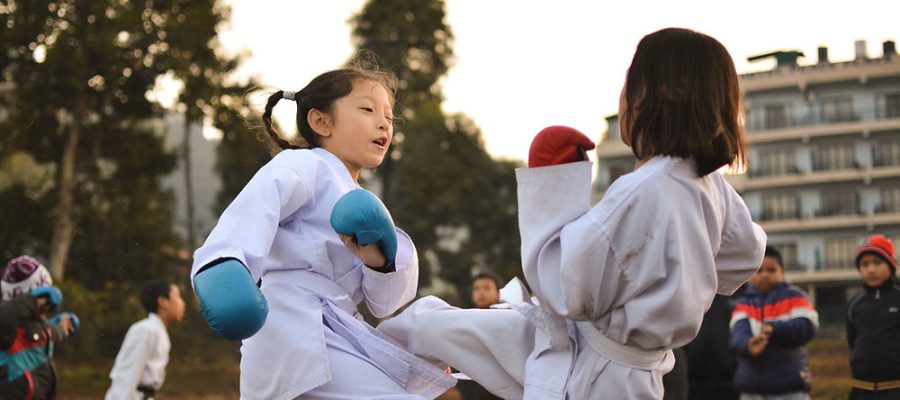
The question we get asked the most, especially during the association’s yearly meeting, is: what is the difference between karate and judo? Although both arts come from Japan, there are many differences, both in techniques and beliefs.
Besides your basic knowledge, knowing the differences between karate and judo can assist you in picking the martial art that fits your needs and aims. In this article, we will explore all the differences between karate and judo, while also pointing out the benefits of karate.
Karate: the identity card
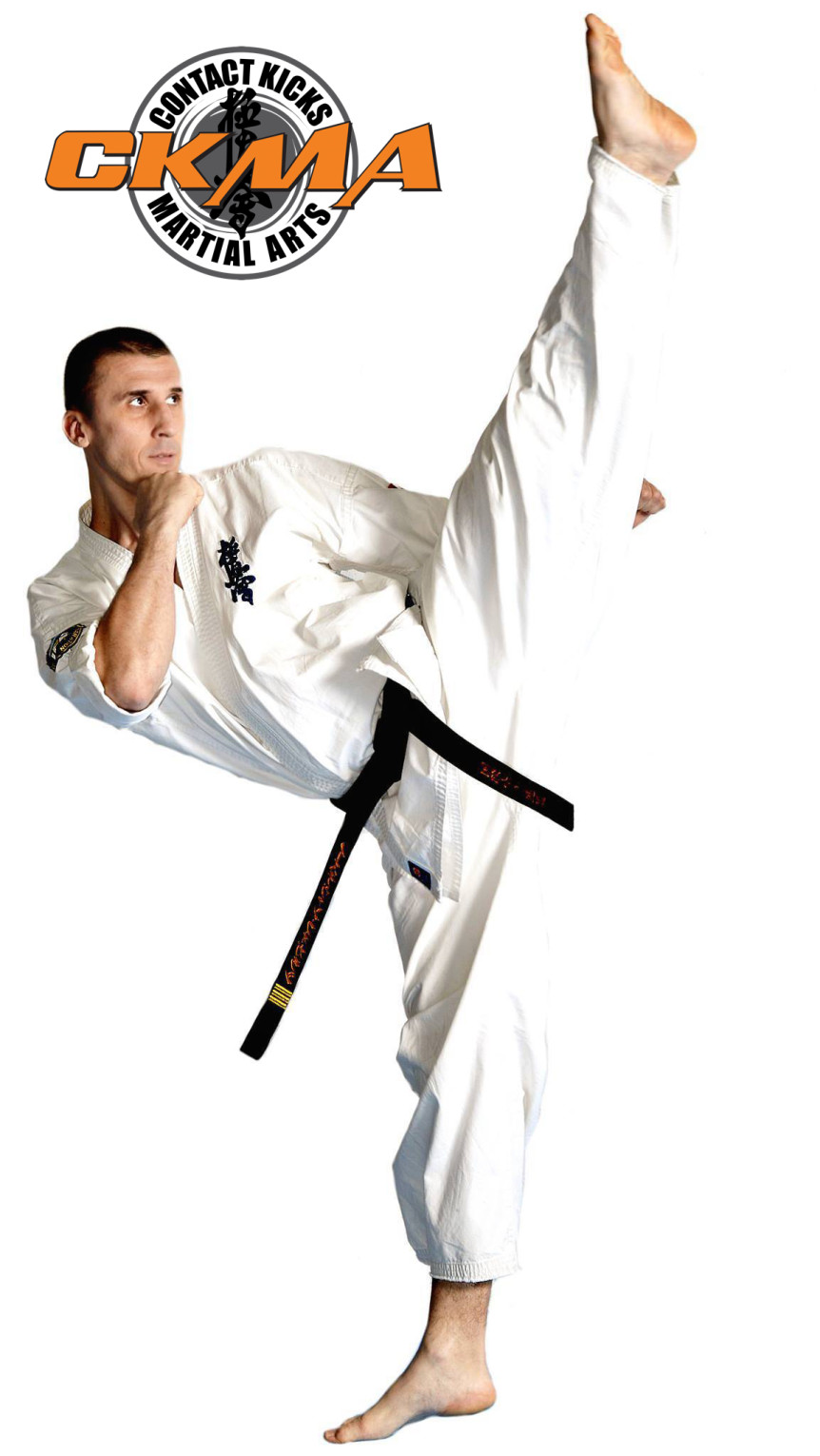
Starting from the island of Okinawa in southern Japan, karate-do (way of the empty hand) was created and popularized by Gichin Funakoshi in the early 20th century. In summary, karate is a combat skill that primarily focuses on punches and kicks, but also on how to stop attacks through defensive moves and blocks.
In karate, there are two forms of fighting: kumite and kata. Kata are routines, a series of defined moves designed to show a pretend battle. In Shotokan karate, there are 26 kata, including the beginner kata which help you practice the moves and the advanced kata, used by the most skilled karate practitioners.
Kumite is a «traditional» match that can last from 1 to 3 minutes, depending on the contest. The competitors are separated by age and weight groups. The matches are not mixed. The goal of a match is to gain the highest number of points once the time runs out. To achieve this, the karateka must hit their opponent using foot strikes and punches.
Judo: the identity card
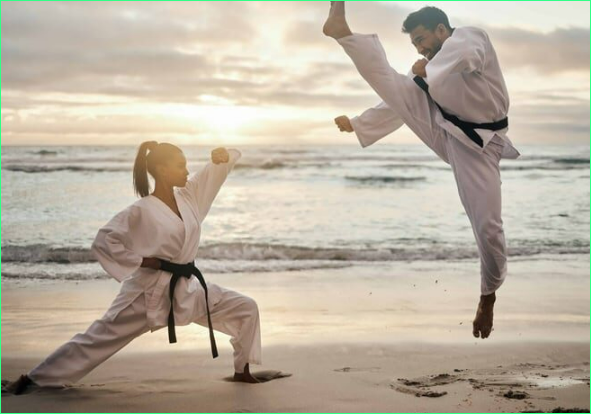
Also originating from Japan, judo (way of flexibility) was created in 1882 by Jigoro Kano. Unlike karate, judo places more emphasis on grappling and throwing techniques. The objective of judo is to bring the opponent to the ground using holds and chokes. In judo you don’t kick or punch.
Judo techniques are divided into two main families: ground techniques (Ne-Waza) and standing techniques (Tachi-Waza). Within these two categories there are subcategories. These subcategories include choke techniques, key techniques, hip techniques, and even leg techniques.
Just like karate, judo is a very competitive sport. The proof is with the multiple world and Olympic champion Teddy Riner. Although 1v1 fighting remains the main type of confrontation, there are also kata in judo. These are important to know, especially for grade transitions. The fighters are also divided by weight and age.
Karate vs Judo: Frequently asked questions
At what age can you start karate or judo?
The practice of these two martial arts can generally begin very early from 4 years. In most clubs there are «baby karate» lessons that allow you to start developing children’s motor skills and coordination. At the Castelginest Karate Club we take care of offering fun and instructive exercises.
How much does an annual membership to a karate or judo club cost?
The price of karate and judo lessons depends on the city and club. In general, both martial arts are accessible. At the Karate Club Castelginest the annual membership fee is 160 euros. To this sum must be added €40 for the license from the French Karate Federation. To help you make your choice and convince yourself that karate is the best choice, KCC organizes trial periods and lessons.
Why choose karate rather than judo?
If you are looking for a martial art that offers a complete workout for the body and mind, karate is for you. Karate helps develop strength, speed, endurance and flexibility. It also promotes concentration, discipline and respect. THE karate instills values strengths such as loyalty, honor, kindness and courage.
The last word
Although karate and judo are two martial arts of Japanese origin, they differ in many ways. If you are looking for a sport that combines strength, technique and concentration, karate could be for you. Don’t hesitate to do it contact us If you are looking for a karate club near Toulouse, we will be happy to welcome you to our dojo.
Conclusion
Karate and judo are both respected Japanese martial arts with rich traditions, but they offer distinct approaches to training, self-development, and combat. Understanding these differences is essential for anyone trying to choose the discipline that best matches their interests, goals, and personal preferences. While both arts teach respect, discipline, and perseverance, the path they take to develop these qualities is quite different.
Karate focuses primarily on striking techniques such as punches, kicks, knee strikes, and blocks. It emphasizes precision, timing, speed, coordination, and control. Through the practice of kihon, kata, and kumite, karate practitioners learn to develop strong body awareness, balance, and effective self-defense skills. Karate training also encourages mental concentration, self-discipline, and the ability to remain calm under pressure.
Judo, on the other hand, is centered around throws, grappling, holds, and ground control. Rather than striking an opponent, judo teaches practitioners how to use leverage, balance, and technique to overcome resistance. Training often involves close physical contact, learning how to fall safely, and developing the ability to control an opponent without relying solely on strength. Judo is particularly effective for improving balance, coordination, and tactical thinking in close-range situations.
Choosing between karate and judo depends largely on what a person is looking for in martial arts training. Those who are interested in striking techniques, self-defense, physical conditioning, and a balance of physical and mental discipline may find karate especially rewarding. Karate offers a structured progression that helps students build confidence, improve fitness, and cultivate respect for themselves and others. It is suitable for children, teenagers, and adults, making it a versatile martial art for lifelong practice.
One of the unique strengths of karate is its ability to combine practical self-defense with personal growth. Students not only learn techniques to protect themselves but also develop patience, perseverance, humility, and self-control. The practice extends beyond the dojo, influencing everyday behavior and encouraging a positive mindset in daily life.
latest posts published
What does the name of our dojo “ishin denshin” mean?

Water: the elixir of life and the secret to optimal hydration
Sempai, Kohai and Dohai: respect for the hierarchical system
What is a dojo (道場)? | At the origins of the word
Mitsu no sen (three points) les trois principals initiatives
Karate Belts: Understanding the Order of Ranks
The concept of “Giri”, a profound moral commitment
Kyokun Martial – In karate there is no first attack.
The social economy at the heart of our martial arts center
