
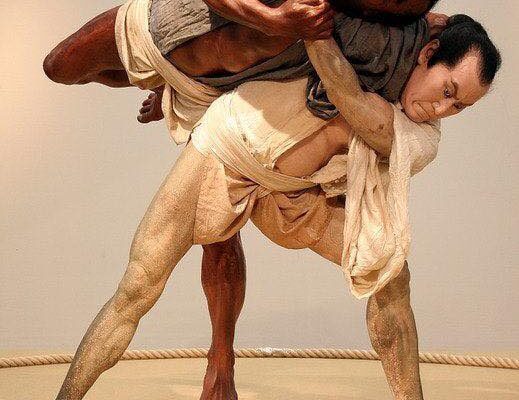
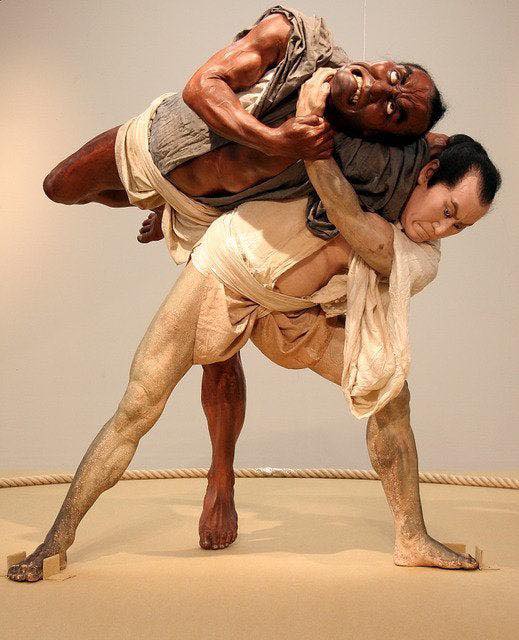
«Fighters #sumo» – Natural sculptureWood painted with natural pigments, glass eyes, human and textile – experimental and extremely realistic art by Yasumuto Kamehachi, 1890.
The Museum of Contemporary Art – Kumamoto, Japan
In addition to the realism and dynamism of the sculpture, we can notice that the two do not look much like sumo today. It seems that SUMO, as a Japanese national art/symbol, has gone through a process of historical and cultural resignation in the modern period of Japan, to connect the relationship with the mythical origins of the Raising Sun, in this new period of affirmation of the Shinto state. It is a process that affects and transforms the entire Japanese socio-cultural landscape that we must take into consideration in the study of any authentic tradition that includes old / classical martial schools, more or less or even «invented» (invented «(inventedHobswn & Ranger).
«Fighters #sumo» – Natural -Mize Sculpture, by Yasumuto Kamehachi, 1890
However, traditions Sumo they are too little explored in relation to martial arts schools. The first fight held that the sumo fight takes place in 23 years (according to the Nihon Shoki Chronicles, 720 en), and ends with his victory Nomi no sukune against him Taima no Kuehayain a game ordered by Emperor Suinin. Nomi no sukunewith a kick, a coast breaks a coast towards his opponent, then with another break and the column, thus killing Taima not Kuehaya, who did not have a good day … does not look at what we see now at sumo competitions. However, the legend is also used to legitimize generic jujutsu schools and is even mentioned in legends relating to the beginning řcolii Takeda / Daito Ryu (Where there are particularly articular and projection techniques and only some advanced forms of striking, obscure, less directed or taught in practice).
Do we find here rather a political motivation, to make a more recent practice old, but also so old as to connect to the (fixed) warriors 2000 years ago and then not to speak at the beginning of the 20th century? It is important to remember that the lack of historical evidence does not mean a lack of value and authenticity in what happens in these schools, and the people who have been doing it for decades, are experiencing examples of mastery and genius and utmost dedication in what they do or have done through their practice.
1. I think it is interesting to approach legend, mythology, from the point of view of symbolic,
non-historical meanings (like Joseph Campbell). This myth of the spear/temporary rescuer/salty exposed appears in Christianity (Jesus on the crosspierced by the spear of Longinus), Marsya of Greek legends, Odin of the Scandinavian ones, Vishnu AND Krishna Also. The liver is a subtle will to live and is even an organ that can regenerate. The column, however, is a vertical axis, it is the unit. Its brokenness signifies the lack of connection to the lands of heaven, the lack of true integration in nature and a concession to its rhythms. Sometimes it’s not about the apparent winners and the meanings of the story itself.
2. Both the legend from 1300/2000 years ago and the statue from 130 years ago
seem to indicate the existence of a sum of sum used not only ritually but also as immediate martial value. We note that they are not overweight people like SUMO today who clearly put unnecessary pressure on the heart and circulation with this physique and which is useless in the fight. These are ordinary people with a special baggage of knowledge, which has gone beyond the sphere of simple ritual plates. Some of them may be a little for some practitioners Daito Ryu / Takeda Ryu What they knew and methodology of sumo training (Takeda Sokichi, Takeda Sogaku, Hisa Takumamembers Takeda / Gennyosha from Fukuoka, etc.). And on the other hand, at least two schools of Jujutsu Who practice, they have at least 200-300 year old sets of anti-Syumo techniques in their technical scrolls and curriculum. And it is very interesting both as a type of internal practice and as a strategy, obviously.
A topic I will reach for both in my academic study and in future Aikijutsu/Jujutsu seminars.
Ps. Have you seen the latest Japanese series with SUMO «Sanctuary»? It’s on Netflix (8 EPs) and plays well from the unspoken and hidden (hate) realities of the extremely Japanese universe.
latest posts published
What does the name of our dojo “ishin denshin” mean?

Water: the elixir of life and the secret to optimal hydration
Sempai, Kohai and Dohai: respect for the hierarchical system
What is a dojo (道場)? | At the origins of the word
Mitsu no sen (three points) les trois principals initiatives
Karate Belts: Understanding the Order of Ranks
The concept of “Giri”, a profound moral commitment
Kyokun Martial – In karate there is no first attack.
The social economy at the heart of our martial arts center
