
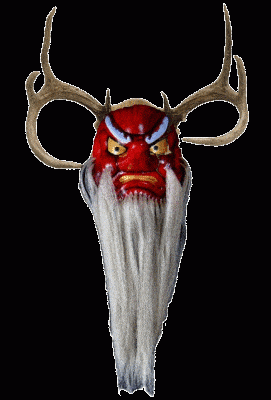
The Bujinkan training sessions were not interrupted even at Honbu Dojo nor with most of the Shihan of the Bujinkan. A little late due to the snowy streets, Soke arrives in the room and presents us with his latest acquisition: a mask with a long nose, mounted on a hunting trophy with deer antlers…
«- Do you know what that means?«
asked Soke laughing.. Most of them recognized the long-nosed figure, the famous Tengu of Japanese martial and mythological folklore (a «celestial dog» with a bird’s head and a long nose that lives in the mountains, sometimes plays pranks on travelers and inspires the sincere in their martial quests).
“- He is more than a Tengu, he is a «mysterious Tengu» because of those horns which do not identify him with the Tengu as we know them. It’s something that ranges from the bizarre to the mysterious in the sense of transcendent, from another world..«. The little nuances that Soke often uses have been carefully translated and sometimes even detailed by Dr. Kacem Zoughari long established in Japan, which on this occasion he translated into Honbu.
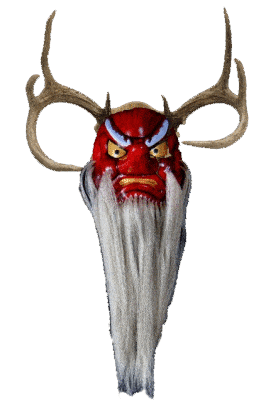
Soke added this Tengu Mysteries it’s like a mutant or a biological anomaly that you can’t classify into the usual patterns. What does this have to do with martial arts, many may ask.
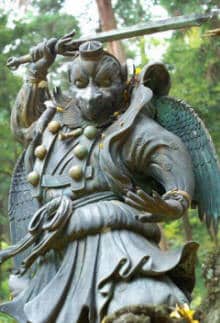
«- In a modern world where you can be killed remotely by cars, what’s the point of studying a martial art? Perhaps many ask this in relation to their passion for the ancestral combat systems of the samurai or ninja.. What else is it for… Well, you have to follow the transition from «martial» to something «mysterious» through what you practice. Yes, mysterious like a ghost, a demon, and in the history and mythology of Japan there are many such examples. Of course, there are such examples in the mythologies of the countries you come from… Well, fighting a man, no matter how well trained he is, as a martial artist at some point you will understand his weaknesses, his system and his structure. But how to apply the arm or leg technique on a ghost, how to shoot a demon? The opponent doesn’t have to understand you at all… you have to be a kind of mutant for him and this doesn’t just mean a superior technique… It’s already another level of martial practice. We will do it today too… Try not to see only with your eyes..“
Training begins with one Fudoken contrasted with Dori muzzle. Soke explains a counter-procedure on this Muso Dori which somehow involves the use of the shoulder separated from the body through a movement on the border between flexible and dislocated. The first technique demonstrated as a counterprocedure was more or less familiar to me, at first glance…
Although Soke talks about the shoulder, it seems to me that he moved with his whole body, ran (Nagare), as we should always do to understand the opponent. Soke on the other hand is 83 years old, he is thin with the same gi as before which is now very large. Maybe that’s why I didn’t understand what he meant. But it doesn’t seem like this is yet a conventional form of counter-technique… Kaeshi Waza…
Povestia unui Tengu Mysterios sau Introducing
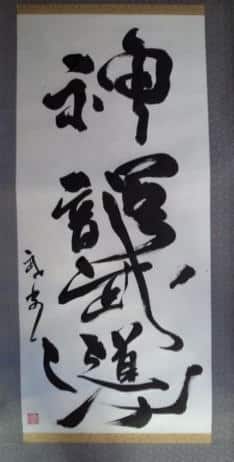
Only the technique that followed was truly surprising because despite following the opponent’s movements (Married) at a certain point, Soke’s shoulder jumped as if it were detaching from the wrist, totally destroying the opponent’s attack… If at 3-4 m this movement was a shock for me, I don’t understand what Soke’s Uke felt in that moment… It’s as if I were made up of parts that at a given moment decide to take him in another direction… I don’t think it hurt that much because he was mentally blocked and perhaps not only that… Soke laughs and reminds us that technique must be mysterious… Really writing Kihon Waza, the Soke chooses the kanji not for the fundamental technique but for the mysterious technique…
“- I can’t teach you this, but you saw… Do the same!!«- Soke exhorts us, laughing… Everything lasted less than 5 minutes. But these 5 minutes with the initial part fully justified the trip to the dojo through the snowfields and also the trip to Japan… Kacem tells me after the course that the technique is even mentioned in the densho Togakure Ryu and not only that.
And all this is closely linked to the theme suggested by the Soke for this year: Martial arts Shin In Bu Do Shen Yun . It’s a play on words, as often happens Hatsumi Sensei. Budo is written to mean «to lead, guide in a martial manner», Shin or Jin/Kami means Divine and «In» has the meaning of rhythm or tone. A generic translation would be “Divine inspiration in martial activities” and probably everyone, depending on their experience and degree of perception, will find numerous collateral meanings… However, it is a beautiful theme for meditation inside and outside the dojo.
latest posts published
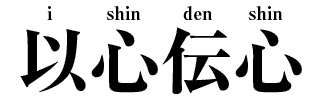
What does the name of our dojo “ishin denshin” mean?

Water: the elixir of life and the secret to optimal hydration
Sempai, Kohai and Dohai: respect for the hierarchical system
What is a dojo (道場)? | At the origins of the word
Mitsu no sen (three points) les trois principals initiatives
Karate Belts: Understanding the Order of Ranks
The concept of “Giri”, a profound moral commitment
Kyokun Martial – In karate there is no first attack.
The social economy at the heart of our martial arts center
