
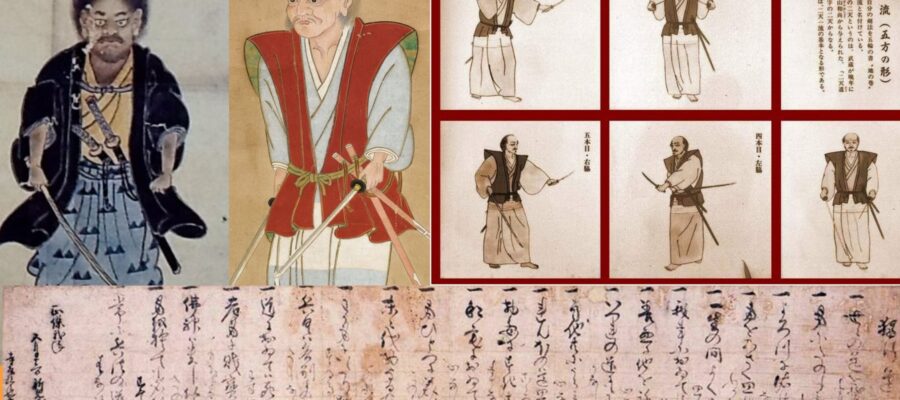
On 12 May 1645, the famous warrior Miyamoto Musashiblocked on paper, a set of 21 principlesinheritance of his disciple Teramo MainosukeWith the renunciation of the few assets he had, suffering from different diseases.
While its famous treatise, Gorin No Sho It has been lost and reconstituted (mainly in Kana, not Kanji – from where possible errors, confusion or addition of its students) this text is authenticated as written by his hand Musashi And it expresses a rigorous, honest and ascetic ascetic vision.
An extremely troubled life has started difficult for childhood and very lonely, without a recognized or assumed master – to which you can feel and express gratitude, human closeness and other feelings of the genre that will satisfy the human and spiritual side of his art and research.
Musashi’s principles written by him 7 days before his death

I admit that because of this sad and cold solitude (because there can be alone, when you have an open heart and make the fragility of your little ego) and an unnatural «forcing» on the path, I did not choose to study his sword practice at the beginning. But I met her in various forms in Japan. At the beginning I learned that Musashi was not the first and obviously the last to analyze the fight with two swords. There were nito techniques in the oldest traditions of MusashiPleases Katori (with which I flirted at the old times, in the 99th and 2000), so I discovered them as applications in Yagyu Shingan Ryu transmitted by several masters including Shimazu sensei AND Machida Sensei. Of course, after Musashi, other schools appeared where the use of both swords is the official part of the program as SHINGYOTO RYU (More recent school, end of Edo). Also one of the branches of Come on Ryu transmitted by the little known Yoshida KotaroIt has an entire roll (DENSHO) dedicated to the techniques of Aiki Nito Ryu! And schools like Yagyu Shinkage Analyzes Musashi from the moment, counter -control, with a sword and two swords! I hope it is clear to everyone that it is not the technique that makes the difference, but the man, because it is the one who applies it with a better or weaker timing, with serious force, intuition or grace … each of the possibilities … finally, for some time, thanks to different special teachers, more withdrawn as presence, some involved in Shinkage RyuI also debuted in practice Niten Ichi RyuMore precisely in two versions (rare branch of Higo and that of Miyazawa Sensei) that we will turn to the seminary on Saturday (25.11.2023) «In Musashi’s steps» – Kenjutsu’s practical seminar, fighting with 2 swordsthat I can’t wait!
And now a possible translation in this Musashi text written only a week before dying
«Dokkōdō» – «The road I go alone»
1. I will never act contrary to universal paths.
2. I will not seek pleasures in people or actions.
3. I never try to snatch a moment of ease.
4. I think a little of myself, most of the others.
5. I am totally detached from desires for life.
6. I don’t regret what I did.
7. I never envy the others, good or bad.
8. I have never saddened the fact that I am separated from anyone or nothing.
9. Even I even reproach myself.
10. I am not guided by lust or sensuality.
11. Posts, antipathies – I don’t have at all.
12. Wherever I live, I will not look for luxury.
13. I never want refined food.
14. I never have objects that become precious in the future.
15. I trust myself and I don’t listen to superstitions.
16. I am not interested in objects of any kind, except the swords and other weapons.
17. I’m ready to die following these principles.
18. I would never want to have a wealth that puts my comfortable old age.
19. The gods and the Buddha are worthy of respect, but I don’t want anything from them.
20. I would prefer to give my life rather than to shame my name.
21. Never, my heart and my soul never differ from the path of the strategy (Heho).
The text can be interpreted in one way and face, but it is essential to take into account the other writings – Gorin No Sho (treated of 5 articles / rings), Hyoho Sanjugo (The 35 strategies) and the teachings of those who carry on the school, on the branches in which it has left. Do not take into consideration the novel by Musashi by Yoshikawa, which has minimal historical ties with reality, being a product of the Japanese society (military), looking for historical identities and reference points (easy to manufacture from the media).
latest posts published
What does the name of our dojo “ishin denshin” mean?

Water: the elixir of life and the secret to optimal hydration
Sempai, Kohai and Dohai: respect for the hierarchical system
What is a dojo (道場)? | At the origins of the word
Mitsu no sen (three points) les trois principals initiatives

Karate Belts: Understanding the Order of Ranks
The concept of “Giri”, a profound moral commitment
Kyokun Martial – In karate there is no first attack.
The social economy at the heart of our martial arts center
