
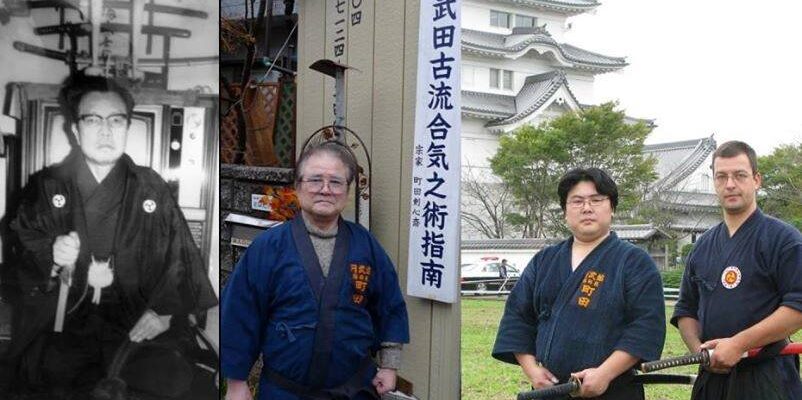
I take up one of the older notes (which FB no longer considers useful so you can only access from old actions or scroll to the publication date) and try to update, dedicating it to the memory of Kancho Machida Kenshinsai.
Although for the most part, the name of Kodokan Perhaps it is synonymous with judo, for the Japanese, Kodokan is just a name of organization or Dojo (written with various kanji). Before the main dojo of Jigoro Kano To bear the name Kodokan there was another famous dojo in Edo, with the same name but written differently – Kōdōkan (弘道弘道弘道) which was the headquarters of the famous Samurai myth school – a true academy for training Samurai as complex and complete personalities, according to the model Bunbu Ryodo („double way of sword and pen» – A sign that one-sided training is not good, a balance must be maintained, compensating military practice with humanistic disciplines).
Mito „Bushido” … play with Mito, another Kodokan si Kancho Machida
I actually first heard about the school in Mito, by 2016 when Machida Sensei He recited to me with close eyes, entire passages on the ethics and spirit of the samurai, quite difficult to understand, which he explained to me that they came from the teachings Mito Gaku (Mito School) taught internally Kodokan Dojo where his family had originated from Mito (on his father’s line) had formed. Hence my interest in the teachings of this real medieval university that created its own code, a real «Bushido» of the Mito clan. Myth Gaku It is a notable example for several reasons.
Founded in early Edo by Tokugawa Mitsukuni – The leader of the Mito clan, the school was initially a confusing / Taoist / Shinto current thought. Next Myth Gaku turns with the help of Tokuiki, an ambitious 9 lea mythin the largest institution for training young Samurai in Edo.
A strong historical study society works in parallel with Mito Gaku, supported by Tokugawa Mitsukuni with the declared aim of studying and modifying the first great history of Japan (Dainihonshi – Great Japanese history). Parallel to the story, Mito Gaku incorporated various disciplines, martial arts, of course, mathematics, astronomy, Shinto and Confuciality, Taoism, Budism and even music. The monumental historical work Dainihonehi was finally completed in the 19th and 20th centuries although the institution closed during the Meiji Restoration (1872). Some of its buildings have even become part of Tezaurului Cultural Japonez (Jūyō Bunkazai)!
This is interesting because although Kancho Machidahe did not attend the courses of this school and learned them extremely with his father, who, and now over 80 years old, recites them, with passion … I also appreciate Machida Sensei once, for the open way he teaches today, despite the slogan propagation then since then since then Mitogaku – Sleep Jōi, «Tilt yourself towards the emperor, out with the barbarians“.
The only data, Machida Sensei
He also told me that he had a hard time understanding these times (after Meiji and especially what followed after World War II). He told me that his father would not have conceived of teaching martial arts to a gaijin like me and that he even shared the same conception until recently. Now, however, he has understood that things change and that those who work and aspire honestly, deserve to know and know, regardless of the country in which they were born and his eyes shine differently when he tells me … communicating a mix of melancholy but also joy and hope. He also tells me that he knows that after he goes «over» he will have a lot to explain to his father… but that he assumes all of this. And now that he has already met his father, I hope this transition has been smooth.
Soshihan Takeshi Machita Fudoshin He is the one who continues this tradition now, also a special man doubled by an excellent martial arts expert who honors his father and I can say that I am lucky to be a student and contribute to a tradition that continues!
* „Bushido«In its current acceptance it is an invention of the early 20th century («invented tradition» – a term introduced into the story by Hobsbawn & Ranger) and extremist/nationalist of the Japanese translation period seeking some kind of national and cultural survival in the face of the encroachment of Meiji Western culture.»Bushido«It was redefined and popularized by the young man at that time Inizo Nitobe, a student in the United States, without much knowledge about Japanese history, through the book of the same name, irrelevant to the true culture of the Samurai class. (Details here: http://www.tofugu.com/2014/12/08/bushido-way-total-bullshit/).
latest posts published
What does the name of our dojo “ishin denshin” mean?

Water: the elixir of life and the secret to optimal hydration
Sempai, Kohai and Dohai: respect for the hierarchical system
What is a dojo (道場)? | At the origins of the word
Mitsu no sen (three points) les trois principals initiatives

Karate Belts: Understanding the Order of Ranks
The concept of “Giri”, a profound moral commitment
Kyokun Martial – In karate there is no first attack.
The social economy at the heart of our martial arts center
