
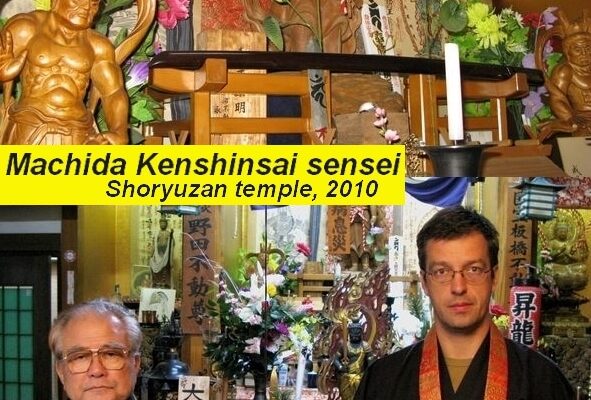
Material (re) written after a 2010 experience with my teacher Machita Kenshinsai THE The temple of Shoryuzan where I lived in Japan
I don’t remember when I put a wooden sword for the first time, what we call in the Japanese martial arts Bokken or Bokuto … this is because the wooden sword probably seems only a piece of wood, which we use waiting for the «real sword of samurai»- probably as an acute and beautiful. Us We often put expectations in that external thing that will make everything better, magical, without our effort.
But I remember very well when, in 1993, I was happy in my hands my first Japanese katana – a fact that in reality (training sword that is not cut), purchased after serious savings. Practicing yourself with Katana, in some way resembles practicing with a Bokken – The movements are equally difficult, the same sweat, perhaps even more difficult in this case even the frustrations are even larger … After the simple grip, the tendons remind us that there is something difficult that runs out and there is almost a vague refusal, or at least we do not hear it. Especially after a period of time you learn martial arts with an empty hand and already feel that you make them even easier than at the beginning, moving on to arms techniques is frustrating again. Above all because it is another working distance but perhaps even more because we do not know how to use our hands to generate the desired effect at the end of the weapon. It is the inability to generate great strength but without precision … or exercise some control but without firmness …
All this happens due to a common myth in modern martial arts:
«First we learn the techniques with an empty hand, only then weapons, which are for advanced …»
A classic example of this modern manipulation is found in Aikido, which is said to be derived from the practice of the sword and that the movements are made exactly as in the art of the sword. The logical conclusion would be that for a good Aikido needs a correct sword practice (which Ueshiba had behind) but generally those sword techniques are not really studied or are considered from the beginning as simple / obvious. An average Aikidoka would have an unpleasant surprise in front of an average Kendoka, who tries to apply a beautiful circular dodge on a trivial but determined Tsuki, without conventions (Yakusoku). And I think the surprises would be the same on the sword or on an attack similar to empty hand …
16 years later, I arrived in Japan a Machida Sensei, Okuden Shihan On the Ryu Aikijutsu Takeda but also with a higher level in various reliable sword schools such as: Enhin Itto Ryu, Mugai Ryu Kodachi, Jigen Ryu. Sensei Machida does not conceive of practicing the Aikijutsu without seriously getting to know the sword and does not even teach anyone Aikijutsu until after the complete bases of Kenjutsu or Iaijutsu (a very martial IAi called corrected jutsu). I was not accepted as a student, with the obligation to study in depth the sword to learn and Aikijutsu and after a period of supported training, Sensei Machida He gave me permission to stay permanently with him in the temple Shoryuzan Din Province Chiba.
Returning here the third time in 2010, my eyes were attracted to a kind of strange rod under one of the shelves of the temple, a little dragons and statues, the multitude of colors and ideograms that crowd the interior of a Temple of Shingon. When I touch it I already have a strange feeling, the barrel is almost a kind of iron, shiny and very dense, difficult. It is a physical weight but also another type of carriage that this rod brings with it … they are courage and I take it from the place of its hiding place and I realize that it is a Bokken with a typical form of school Itto ryualmost straight, often, with long tsuka (handle) just like the old swords in Muromachi / Nanbokucho. The weight, the feeling that leaves to the touch are difficult to describe. Only after sitting in Seigan No Kamae with Bokken, do I realize that the handle is not only sculpted, but that sculpture is in the form of a superb resistance, with an open mouth. Then I thought Kurikara Ryu – The dragon curled up on the right sword Ken, one of the main esoteric symbols that often replace the classic image of Fudo Myo o -A of the main divinities of the samurai, revered above all for its ability to concentrate the mind and non -attack. It was clearly a special Bokken and while I hold it in my hand I appreciate more, it is a connection with the weapon that I feel better that with Katana somehow paradoxically. I have to ask him Machida Sensei On this formidable Bokken necessarily.
He said and asked, one of my first questions the next day concerns this Bokken. His face Machida Sensei Lights:
-I have discovered the Bokken from Tetsuboku !!! He is a bokken covered with Urushi, he is not a Bokken for Bujutsu, he is a Bokken for Shugyo (individual austere practice)! Sensei Machida becomes silent and analyzes my reaction. Urushi, continues Densul, is a special lake in Japan, an expensive resin because it can only be collected by a certain species of trees.
He doesn’t know how to explain to Tetsuboku but the name is already significant: «Tetsu» means steel and wood «Boku». It is an ebony species – very hard, rare and obviously expensive wood. As an update of the material, at least 2-3 years, this type of ebony is protected and export is prohibited (it can no longer be purchased)
» – It is a Bokken only for Shugyo continue Machida SenseiOnly for your inner practice, not for Kenjutsu with a partner. Although Tetsuboku is hard and could support any impact, the Urushi layer deteriorated at the slightest impact that would explain to me Machida Sensei. By practicing with this Bokken, perfect and strengthen your interior and this without violence: you are not allowed to hit anything from the outside. In this way it becomes very strong inside, but outside there is no need for hardness, only supplement, beauty and sensitivity. This is the Urushi layer! It is the type of construction in – Yo (Yin Yang) that you need to build in your body, since this Bokken is built. All this makes sense, such a profound meaning, especially that in some way I have perceived it, but not in this size.
Sensei then shows me to exemplifies the sword techniques already practiced and in the last few days with this Bokken – it is visibly transfigured. It is not really Machida Sensei In front of the house, the martial art of the arts, but it is more Sendatsu Machida Sensei – The serene and calm priest during a ceremony, a sublime mixture of apparently furious Fudo Myo o and the preamble goddess of Kannon’s compassion. This transfiguration is surprising and reminds me of the shape of shamanism. Fact correctly, on a more advanced level, martial practices, repetitive, special and rhythmic exercises could induce tranches, modified states of consciousness and from here and the revelations that some masters in their practice. It is a topic I will return to.
At the time to continue to practice with the techniques of Iaito The Sword, but sometimes the thought flies to the Bokken next to the altar of the temple. In the evening I train with him in the temple, with great care not to hit him and not to hit something around. Or I wonder and dream with him in his hand. It is a special experience. One day, he even finds me to practice in the temple and, after drinking our tea to speak, practice and talk about the relationship between Aikijutsu, breathing, Mudre, Sensei tells me that I would have been attracted to that Bokken … 🙂 Yes, so it was obvious, I don’t like it, but I don’t need it. who understood. He tells me that he likes it very much, that practically the open mouth of the dragon continues through your body and practicing Kenjutsu can therefore become a religious act (re-to-leggi, re-concession). I understand it because I know that it lives towards the divine through its martial practice even if some perceive martial practice in a certain sense and the spiritual one separately. For Machida Sensei It is the same thing, the same final purpose.
I remember having talked it about Tameshigiri – Cut the tests on the wet rice straw. He told me that if I train it is not very difficult to do and that it is not even worth praising. The essence of the art of the sword lies behind Swimone laps – to cut something good, placed very close to someone alive. So, with a short movement, totally cut the target but without touching the person- this is the real mastery: cut strong, perfect, decisive and keeping life. If you are open enough (in) and powerful (Yo), then you will hear God-Continue Machida Sensei. I realize how well it applies Suemono laps in practice Shugyo with the Bokken. How close we are to God if we can only get there with a piece of wood.
On the penultimate day, Sensei tells me that he feels that Bokken must be mine and that he will be happy to train intensely with him, to sweat a lot with him, to give toxins, at all levels. Is what is called in Japan «HARARA NO KEIKO«-DeAning who purifies … I was speechless … Sensei tells me that I will only receive him the next day, at the start, because he wants to practice with him and tonight! After the Boken remained on the altar during a final ceremony, goodbye! An extraordinary sense, an extraordinary Bokken … An extraordinary moment …
I know I have to offer this Bokken at least so extraordinary. Miracles are generally close to us, it depends on us if we know how to perceive them or not. Thanks to all those who have made these extraordinary moments directly or indirectly possible
Small ps. As practically with this Bokken, I make the strong connection with it, also physically, beyond emotionally. So, over time, I came to understand better, with my whole body, not only mentally, practicing with Bokken, for now even better than Katana. It took more than 16 years and 4 roads in Japan*! (in 2010)
Certainly my inner life now confirms that every effort has been worth it! Those interested in small metaphysical speculations leave the pleasure of approaching the practical relationship with a wooden weapon, respectively a metal and through the laws and transformations of the 5 elements (enjoy, Gokyo in Mikkyo).
* in 2010 (now there are already over 20 trips)
Thank you also to his son Machida Senseithe current school of the school – Takeshi Machita For all the help given, with the soul open, during my stay there!
latest posts published
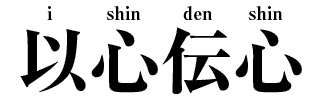
What does the name of our dojo “ishin denshin” mean?

Water: the elixir of life and the secret to optimal hydration
Sempai, Kohai and Dohai: respect for the hierarchical system
What is a dojo (道場)? | At the origins of the word
Mitsu no sen (three points) les trois principals initiatives
Karate Belts: Understanding the Order of Ranks
The concept of “Giri”, a profound moral commitment
Kyokun Martial – In karate there is no first attack.
The social economy at the heart of our martial arts center
