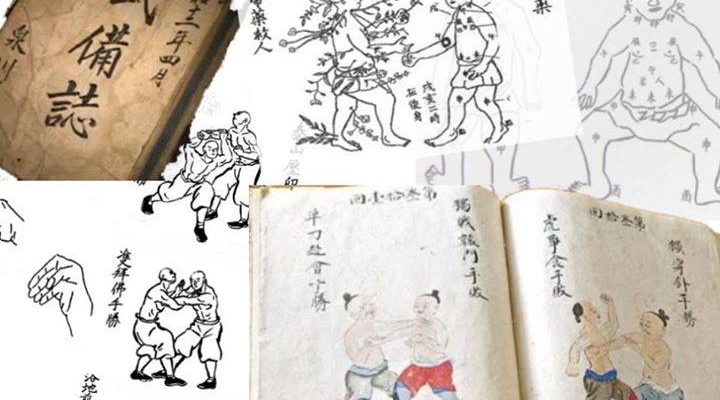
The 8 verses make up a passage from Bubishi – a Chinese text, discovered in Okinawa (actually the Ryukyu kingdom, as it was called then, before the Japanese conquest and annexation).
The text comes from China, where, interestingly, we don’t have many true hand-to-hand martial arts treatises. There are many manuals on military strategy, philosophy, internal schools but fewer on martial arts… With the sending of the «36 families from Fujian to Ryukyu by the Ming dynasty, with the aim of facilitating commercial and political relations between the 2 countries, a great flow of Chinese culture arrived in Okinawa in a very short time (in 1392).
That is an excellent historical and geographical context for one of the most significant documents in the history of Karate and Okinawan martial arts: the Bubishi.
Here is the complemented text and a conclusion, expanding on the Bubishi’s impact and the flow of Chinese martial knowledge.
The Bubishi: A Secret Key to Okinawan Karate
The passage you refer to comes from the Bubishi (Wu Bei Zhi in Chinese), a foundational Chinese text that was discovered in Okinawa (actually the Ryukyu Kingdom, as it was called then, before the Japanese conquest and annexation). The eight verses you mention are often considered a critical excerpt detailing fighting principles or pressure point strikes, forming a core piece of the document.
The text originates from China, where, interestingly, we don’t have many true hand-to-hand martial arts treatises. There are many manuals on military strategy, philosophy, and internal schools, but fewer focused explicitly on the practical, codified techniques of martial arts—making the Bubishi’s existence and transmission all the more significant.
The Flow of Knowledge: The 36 Families
This vital flow of knowledge arrived in Okinawa largely due to the establishment of the community known as the «36 families from Fujian» (Min people). They were sent to Ryukyu by the Ming Dynasty in 1392, with the explicit aim of facilitating commercial and political relations between the two countries. This large migration brought a great flow of Chinese culture to Okinawa in a very short time.
These families, mostly skilled navigators, interpreters, and administrators, settled in the village of Kume-mura near Naha. This settlement was not just a commercial hub; it became a crucial reservoir of Chinese arts, philosophy, and, crucially, martial knowledge—specifically the southern Chinese Fujian White Crane and Monk Fist styles.
The Bubishi itself is believed to be a compilation of secret teachings from these southern Chinese martial arts systems. It was not a public manual but a master’s handbook—a cherished, handwritten document copied and passed down through generations of Okinawan martial arts experts like Kanryo Higaonna and Chōjun Miyagi.
Content and Influence
The Bubishi covers a wide array of topics crucial to the development of Te (the precursor to Karate), including:
-
Eight Precepts: Ethical and philosophical guidelines for martial artists.
-
Techniques: Detailed illustrations and instructions for various striking, grappling, and locking methods.
-
Vital Points (Kyūsho): Detailed charts showing the vulnerable pressure points of the human body and the optimal times to strike them.
-
Herbal Remedies: Medical knowledge for treating injuries sustained during training.
This text served as the «secret manual» that provided the technical and philosophical blueprint for much of modern Okinawan Karate, including Naha-te and later Gōjū-ryū. It offered the theoretical framework that justified and refined the practical training that Okinawans had been quietly developing for centuries.
This manual brought with them by the Chinese and found in Okinawa in various forms/transmissions, does not exist in Fujian or mainland China! It seems like a synthesis work by several experts to those who intended to continue practicing martial arts in their new home: the colony of Kumemura in the Okinawa archipelago.
Text Discovery it became public after 1900, with the export of Okinawan Kenpo and its transformation into first Japanese, then universal Karate… Unfortunately, most of them interpret it on the basis of current forms of Karate, which were formed after 1700 – 1800, while Bubishi is the work of some Chinese masters of the White Rooster + Fujian Kung Fu branches of that period. The text can also be the synthesis work of a diligent student who collects the knowledge acquired in practice. Although it was written in Okinawa, it is written in Chinese and contains references to vital points, meridians and energy pathways, a form without a partner, details on palm tree positions and their energy applications, 48 applications with a partner (extremely rare in general texts), and a special chapter dedicated to medicinal plants…
Here are the 8 rules of Kenpo, which can be easily extrapolated to any form of deep and integrated practice.
1. The person smiles the same way (Jinshiin wa Tenchi on Nature) Natura uman this a Crusui just Pamanutui.
2. Ritmul circulatiei in corp (corporal fluid, subtle element, air, etc ) this is similar to the cycle soarelui si al lunii (exactly cum Ha si Tha din Hatha Yoga means Sun and Moon – clearly indicating the internal alchemy)
3. 法は剛柔を呑吐し (Hô wa Gôjû wo Donto Shi) The method consists of a combination of durability and supplement, absorption and emission (generally applied only to breathing)
4. 身は随時応変す (Mi wa Zuiji ôhen su) Acting in accordance with time and change
5. When the hand meets the sky, enter (Te wa Kû ni Aeba Sunawachi Hairu) Tehnica va apare in wronga gandirii constiente.
6. 進退は碼りて離逢す (Shintai wa Hakarite Rihôsu) The movement of the body is to advance or retreat, to reunite or separate.
7. The eyes must see in four directions (Me wa Shikô wo Miru Koto wo Yôsu)
8. Ears can hear all directions.
These 8 poems are the essence of Kenpô (the law/method of the ‘fist’ – martial method)
Note that beyond the title where the term Pumn – Ken appears, in the rest of the text none of the words have a martial connotation! This is probably why the text is successfully ignored by all practitioners of Okinawan and derivative schools (Karate) – because they have no idea how to use it in practice… or because simply, their practice does not use the concepts of this text (which should be a foundation of the practice! 🙂
Even though we have no martial terms, we only find a maximum of 3 verses that offer relatively physical indications. The text clearly begins with the first verse which suggests a spiritual approach (the most important, because it is the first, right?) Furthermore we continue to have principles of awareness, energy and internal alchemy.
latest posts published
Sempai, Kohai and Dohai: respect for the hierarchical system
What is a dojo (道場)?
Mitsu no sen (three points) les trois principals initiatives
Karate Belts: Understanding the Order of Ranks
The concept of “Giri”, a profound moral commitment

Athlete Imaging | Martial Arts Larry Foisy
Black belts, keepers of knowledge
Kyokun Martial – In karate there is no first attack.
The social economy at the heart of our martial arts center