Recognizing the gesture is important. But to ignore what it reveals would be to miss the opportunity to tell the truth.
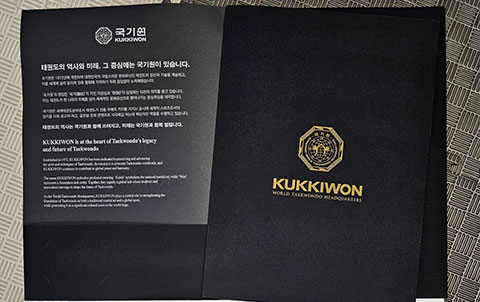
Yesterday I received a gift from Kukkiwon, the global institution that is supposed to be the guardian of Taekwondo’s legacy. A symbolic gesture, certainly, but full of weight and contradiction. I didn’t feel proud when I received it. I heard silence. Not the light silence of someone contemplating something beautiful, but the dense silence of someone who knows what’s behind the package.
I’m not ungrateful. A gesture of recognition, even a shy one, has value. Maybe this gift is an attempt… an attempt to reconnect, to say “we haven’t completely forgotten”. And if so, I accept it. Because every new beginning begins with one step. Even if hesitant.
But it is impossible not to feel discomfort. The gift comes from the house which, in theory, represents the essence of Taekwondo, but which in practice often seems to be surrendered to bureaucracy, politics and entertainment and which has, not infrequently, lost the connection with the base: with the transmitters, with the practitioners, with the values.
Those who experience Taekwondo as a martial path, with discipline, silence, character and dedication have become almost invisible. National sports federations see them as numbers: useful for reports, subsidies and statistics. What we teach, what we transform, the impact we have on students’ lives… it doesn’t matter.
Yet, it is precisely these federations and coaches who chase after Kukkiwon every time they need to validate a competitor’s diploma to allow an athlete to compete abroad. The irony couldn’t be clearer: what is standard to some is offered as fast food to others. An athlete with good results in the championships receives the diploma as if it were a passport. Meanwhile, others spend years training, teaching, seriously experiencing the art, until they deserve it. In the end they are all «certified». It is indisputable to understand who is truly trained.
This facilitation ends up being reflected where it hurts most: in the quality of the coaches. We are increasingly witnessing weak training sessions, aimed only at sporting objectives, without any martial depth. Taekwondo is taught as if it were just a sport. As if philosophy, ritual and inner journey were superfluous details. As if it were enough to train champions instead of training people. We have reached the absurd point of seeing even Karate and Kempo federations wanting to train Taekwondo coaches. It is tradition that is diluted with convenience.
I accept this symbolic gesture, yes. But no illusions. The true transmitters of Taekwondo, those who keep the flame alive even without a stage, deserve more than gifts. They deserve to be listened to, respected and truly appreciated.
The Kukkiwon (World Taekwondo Headquarters) is the global institution responsible for issuing official black belt certifications and maintaining the Poomsae (forms) standards for World Taekwondo (WT) style. Receiving a gift from them, particularly as an elite practitioner, is undoubtedly a formal recognition of your dedication.
The Gesture: Symbolism and Expectation
The gift itself, being a symbolic gesture, represents:
-
Official Recognition: It is an acknowledgment of your rank, contribution, or status within the global Taekwondo community. It signals that you are officially part of the institution’s recognized lineage.
-
Unity and Inclusion: It attempts to draw you closer to the center of power, signaling a desire for harmonious relations with prominent figures in the field.
-
Hoping for Silence: The institution might use such gestures to preemptively silence criticism or foster goodwill, hoping that the act of recognition is enough to overlook structural issues.
The Silence: Contradiction and Truth
Your perception of the «dense silence» and the contradiction points to a critical awareness of the institution’s current state. This «silence» often speaks to the unspoken truths and challenges within global Taekwondo governance:
-
Legacy vs. Commerce: You may be sensing the commercialization of rank and the prioritization of money and politics over the preservation of technical excellence and pure martial arts ethics (Dō). The silence is the sound of ethical compromise.
-
Structural Integrity: The Kukkiwon has faced various administrative and ethical challenges (e.g., issues with certification procedures, leadership disputes). The gift may feel hollow because the systematic integrity that the institution is supposed to represent is perceived as being undermined.
-
The Practitioner’s Burden: Your lack of pride stems from the knowledge that your own hard-earned rank and skill were achieved through personal sacrifice and discipline, not through bureaucratic favors. The gift may feel like an insult to the rigor you underwent, suggesting that dedication can be acknowledged through superficial means.
Perhaps this gift is only the varnished reminder of a much greater debt. A debt to all those who continue to carry Taekwondo on their shoulders with dignity and resilience, even when the system ignores them.
But there is one thing that time teaches: the truth always survives the noise. And when the glow of the medals fades and the news ceases to impress, it will be the invisible ones who will remain standing. Not the ones who got on the podium. But those who never let the path die.
I know that, in the future, we will probably be increasingly rare. Mentors and practitioners who still refuse to dilute Taekwondo in the name of convenience. And it is natural that, athletes and coaches accustomed to such ease, few want to delve into the profound immensity of what Taekwondo has to offer. Because true Taekwondo doesn’t give up, it is conquered. You don’t learn in shortcuts but in time, in pain, in character.
Because what is profound does not seduce at first glance, it requires abandonment. And today few are willing to do it.
We are not «the old people of the rest», we are the root that no one sees, but which supports everything. And even though we seem few today, it only takes one step with the truth to resonate for generations. Taekwondo awaits. Not those who run, but those who know how to stop, breathe… and continue.
latest posts published
Sempai, Kohai and Dohai: respect for the hierarchical system
What is a dojo (道場)?
Mitsu no sen (three points) les trois principals initiatives

Karate Belts: Understanding the Order of Ranks
The concept of “Giri”, a profound moral commitment

Athlete Imaging | Martial Arts Larry Foisy
Black belts, keepers of knowledge
Kyokun Martial – In karate there is no first attack.
The social economy at the heart of our martial arts center