
As teachers or caregivers of a child, we naturally want to be liked by them, but our main job as a teacher is to educate. If in addition to sharing knowledge you can get young people to enjoy your company, you have truly succeeded.
Respect instead of discipline
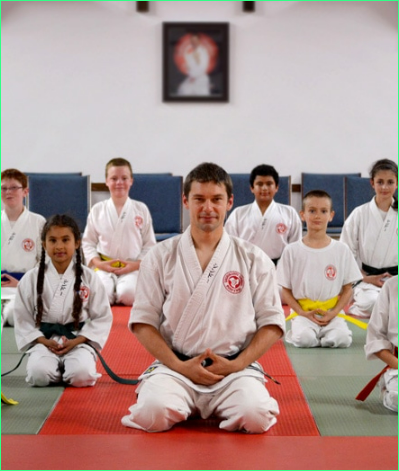
It was after my first ten years of teaching that I started to understand better how to teach martial arts, because many schools loudly advertise “DISCIPLINE” in their promotions. However, when I asked my karate students which word best described the dojo, the word respect came out far ahead of the word discipline. This made me think deeply. I then understood, on one side, that respect is a strong value in me and that, even though my students are often recognized for their discipline, it is uncommon that I need to correct them.
The carrot or the whip?
That’s when everything became clear. Many dojos establish strict discipline to gain the respect of the members, while in my case it is completely different. Furthermore, one must understand that not only is karate of paramount importance to me, but I also teach it on the condition that 3 to 6 hours a day, 5 to 6 times a week. Therefore, if I spent so much energy continually disciplining my students by scolding and berating them, I think it would be unpleasant to endure. Every educator knows that there are two choices: the carrot or the whip. Know that the whip is unpleasant for everyone.
Debunking Renshi’s secrets
But a secret persists; You’re all wondering how I do it. It all starts with good manners. Once we have explained to him why it is necessary to salute when entering the dojo (sign of gratitude), how to sit, what courtesy, etiquette, correctness, empathy and many other principles are, it is up to the karateka to make the right choice regarding his behavior. Not because this choice is imposed on him, but because he knows what the right action to take is based on the values transmitted to him. This is how I build free will which is indeed not common to many dojos, but which corresponds perfectly to our Western reality.
Now apply it
Second mystery: the application of our doctrine. Let’s start from the assumption that unconsciously in children everything is measured in love. Let’s take as an example little Mathieu, who sits very badly. I have two options available: I could take a direct approach and tell him very explicitly that he should sit better. The second option would be to take a moment to congratulate Olivier, his closest neighbor, praising him for how well he sits and telling him that he is a good example. So everyone else will want to have the attention/love I just gave Olivier too.
Mom, dad, watch out for traps!
On the other hand, there are tortuous paths that parents often tend to follow and which cloud the credibility of interventions. Let’s take Mathieu as an example once again, who throws the ball into the window. Dad has two choices. First option: intervene over and over again, always telling Mathieu that this warning will be the last, but in this case Mathieu isn’t sure that there will be 5 or 6 last warnings. Second option: Establish a clear instruction and a clear consequence. Consistency creates an environment in which the child feels safe and, even through the implementation of instructions, the child feels loved and is happy.
In short
In short, teaching martial arts is an art in itself. You could be the champion of champions, have exceptional talent in karate, and still be an average teacher. We who follow the path of martial arts and try to train the individuals who will constitute the society of tomorrow, what do we prefer for them? Who walk upright because it was forced upon them? Or because they know deep down that it’s the right thing to do?
Conclusion
Teaching children is about much more than earning their affection or becoming their favorite instructor. While building a positive relationship with students is important, the primary responsibility of every teacher, coach, or caregiver is to educate, guide, and help children grow into confident, respectful, and responsible individuals. Genuine success comes from finding the balance between kindness and leadership, creating an environment where children feel both supported and challenged.
Young students naturally respond to instructors who are encouraging, patient, and enthusiastic. However, effective teaching sometimes requires making difficult decisions, correcting mistakes, setting clear expectations, and maintaining discipline. These moments may not always be immediately appreciated, but they are essential for helping children develop good habits, resilience, and respect for others. A teacher’s role is not simply to entertain but to provide the structure necessary for meaningful learning.
In martial arts, this responsibility becomes even more significant. Karate is not only about teaching techniques but also about instilling values such as perseverance, humility, courtesy, honesty, and self-control. Children observe the behavior of their instructors just as closely as they listen to their words. For this reason, teachers must lead by example, demonstrating the attitudes and principles they expect their students to adopt both inside and outside the dojo.
A successful instructor understands that every child learns differently. Some require extra encouragement, while others benefit from greater challenges or more individual attention. By recognizing these differences and adapting their teaching methods accordingly, instructors can create an inclusive environment where every student has the opportunity to succeed. When children feel respected, understood, and supported, they become more motivated to learn and more willing to overcome obstacles.
Over time, students often come to appreciate the guidance that once seemed demanding. The discipline, confidence, and life skills they develop through consistent instruction frequently extend far beyond martial arts training. Lessons about respect, responsibility, teamwork, and perseverance become valuable tools that help them navigate school, relationships, and future challenges with greater maturity.
latest posts published
What does the name of our dojo “ishin denshin” mean?

Water: the elixir of life and the secret to optimal hydration
Sempai, Kohai and Dohai: respect for the hierarchical system
What is a dojo (道場)? | At the origins of the word
Mitsu no sen (three points) les trois principals initiatives

Karate Belts: Understanding the Order of Ranks
The concept of “Giri”, a profound moral commitment
Kyokun Martial – In karate there is no first attack.
The social economy at the heart of our martial arts center
