
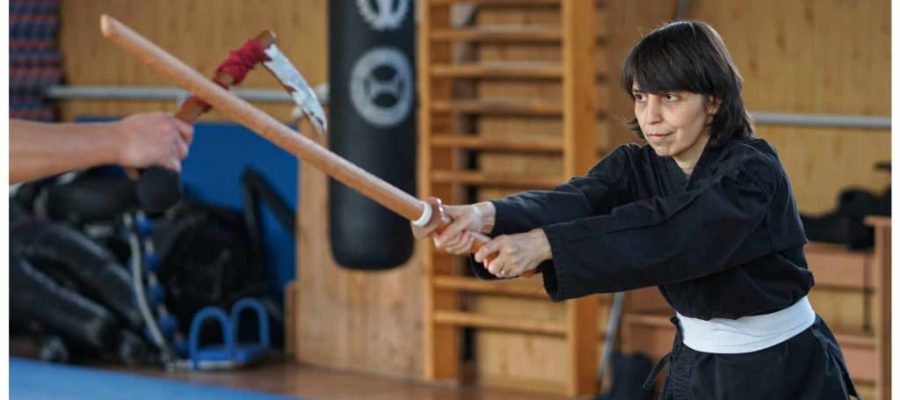
Yes, considering I received this compliment after January 2 (no, the day I became more mature, wiser, more reasonable and at peace with myself), I easily avoided unnecessary drama. 🙂
I have heard several friends/acquaintances use the fact of not having talent as an excuse for not practicing a sport… Some friends have even asked me if you have to have talent to practice martial arts… No, it’s not necessary duty! It was important to me like him very much which is what I do too believe in that thing, in that activity. Then they get to the package dedication, perseverance, discipline…Talent? It does not exist in this equation. At least not for me. I am the perfect example of this you can do very well without talent. 🙂
In these two years without a month (February 10th marks 2 years since I started practicing ninjutsu), I have had the opportunity to observe my colleagues practicing Aikijutsu, Taiji and Qigong, Ninjutsu AND Kenjutsu. There is a clear connection between them (I mean the movements, the principles), but it is fascinating when you realize the clear identity of each individual discipline. There is an energy, a special atmosphere specific to them. Fridays are absolutely amazing Raiden Dojo because in the gym there are practitioners of NinjutsuFrom Taiji and Qigong and of Aikijutsu. Each group develops its own rhythm, its own energy and focuses on what it repeats. I can’t boast that I can get into the necessary atmosphere, that I can always «borrow» from the energy of the group, even if I am aware that it is there. But I can’t always «access» it.
I find it fabulous that Sensei is able to give explanations to everyone, adapting to the specificities of each group. There is a flexibility that I will most likely never achieve! But I tend towards this, I force myself. Each discipline has a special, specific flow, a specific way to speed up movements and slow them down. I say this because I have the photo before my eyes and the differences and similarities between the disciplines are so evident that one has the impression that they are palpable. I find it amazing that Sensei can be so many ways at the same time, that he can switch between them, fitting perfectly into their flow. It’s proof that it’s not impossible.
But what I wanted to say is this there is room for the talentless under the sun.  So… talentless people from all over, unite and come to the gym because you will definitely find the right rhythm there! 🙂
Conclusion
That unexpected compliment during sword class reminded me how much growth can happen quietly, beneath our own awareness. What once might have wounded my pride now made me smile—a sign that I’ve learned to see progress differently. It’s not about being better at one discipline than another; it’s about the journey of improvement, the patience to keep showing up, and the humility to accept where we are. A simple comment, “You are better at swordsmanship than ninjutsu,” no longer feels like a comparison, but rather an acknowledgment of dedication and time spent refining movement, focus, and presence.
Over the past year, I’ve realized that progress doesn’t always appear where we expect it. Sometimes, one path flourishes faster, while another demands more effort, more heart. My connection to ninjutsu may not come as naturally, but it continues to teach me resilience, discipline, and acceptance. Holding on to this art, even when it challenges me, is a form of respect—not just for the practice, but for the person I’m becoming through it.
What I once saw as imbalance, I now understand as harmony in progress. Swordsmanship and ninjutsu are not rivals within me—they are reflections of different aspects of the same pursuit: to know myself better, to refine both body and spirit. Every class, every strike, every imperfect attempt carries meaning.
So, I take that compliment not as a destination, but as encouragement to continue walking both paths—with gratitude, curiosity, and joy. Whether the bokken hisses or not, what matters most is the quiet determination to keep learning, to keep practicing, and to honor the beauty of every step along the way.
latest posts published

Come try karate for free from June 12th to 30th at KCC
Why join the KCC for the 2025/2026 season?
Why join the KCC for the 2025/2026 season?
What sport can a 4 year old do?
Winning double for KCC
Towards the Coupe de France for the KCC
KCC: the 2023 pre-exam course
What are the belts and ranks in Karate?
What are the different styles of Karate?