
“Once I was sitting in my master’s room when he said to me: Close your eyes and wait, whatever happens, make sure you don’t open them…” Then I heard my master walk away and go down the stairs and I think it was then that I lowered my guard knowing that he was no longer near. After a few hours, some sort of massive and overwhelming presence approached diagonally from behind me and having the image of my body cut in two, I felt the need to escape by rolling straight from the position I was waiting in. Then I had the strange impression of a head flying, so I did a sudden frontal fall like the first somersault. As soon as I sat down in Fudoza, I heard my master’s voice Takamatsu Sensei who told me: «Very good, you did it, now you can open your eyes!«Turning around, I saw the sensei lowering a real sword (shinken).
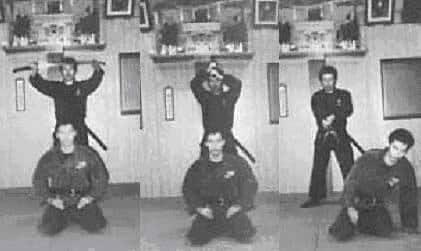
Coming to my senses and thinking about this strange episode, I remember asking for explanations several times Kijutsu Kijutsu (energy technique)a sixth sense or we could even call it Shinden no Jutsu (divine technique) so that Gokui 極意 (deep penetration) which says that when you think it’s here, it really isn’t, and when you think it’s not, it really is.
Now, for the first time, these profound teachings penetrated my body and soul with unimaginable weight. I was deeply impressed by the nature of these subtle teachings. Along with the joy in my eyes at this moment, my master gave me that sword. Sensei later told me that this was the case Jujikiri Mumyo no Itto and that no one has gotten that far. These words said with such joy, I always remember them as if they were said yesterday.»
It should be noted that this test Bag it is not a finality, it is just an initiation into what goes beyond purely physical training, it is the moment in which we are prepared for a different type of training, another opening to other perspectives. Kokoro no Budo we always remember Hatsumi sensei, a Budo lived intensely with the soul, much more than with the body…
* Maybe it’s his step Lao Tse from the Tao te King spoken of Cale (Do/Tao) like when you think you are walking on the Path, you are actually not there at all and when you are not thinking, you are actually on the Path…
Conclusion
Receiving the sword from my master marked a profound moment of initiation, one that transcended the physical dimensions of training and entered the realm of the spirit. That moment, paired with the words of Hatsumi Sensei, revealed the depth of Kokoro no Budo—a martial path lived with the soul rather than the body alone. It was not an endpoint, but a gateway: an opening to new perspectives, new awareness, and a more intimate understanding of the art’s essence. The sword became more than a weapon; it became a symbol of responsibility, presence, and the ongoing journey of inner development.
This initiation illustrates the subtlety and depth of true martial training. Techniques, forms, and repetition are only the surface. The real transformation occurs when the body, mind, and spirit converge—when one moves beyond conscious striving and enters a state of fluid awareness. As in Lao Tse’s teachings from the Tao Te Ching, walking the path is paradoxical: conscious effort alone cannot lead you fully there, yet surrender and quiet attention reveal the true way. In this sense, martial arts become a mirror of life, teaching us to act with awareness, humility, and harmony, even in moments of stillness or apparent inaction.
Moments like these, where master, student, and tradition meet, remind us that the martial path is ultimately about understanding oneself. The sword, the teachings, and the silent guidance of the master converge to show that progress is not measured in skill alone, but in depth of perception, alignment of intention, and openness to the invisible lessons that lie beyond the forms. True Budo is therefore a lifelong practice of the soul, a journey that continues long after the physical techniques have been learned, calling us to live fully, attentively, and harmoniously with the essence of the art.
latest posts published

Come try karate for free from June 12th to 30th at KCC
Why join the KCC for the 2025/2026 season?
Why join the KCC for the 2025/2026 season?
What sport can a 4 year old do?
Winning double for KCC
Towards the Coupe de France for the KCC
KCC: the 2023 pre-exam course
What are the belts and ranks in Karate?
What are the different styles of Karate?