

At the end of each kata or exercise, after giving the decisive blow, there is this Zandhin in which you are calm, breath, you are aware of the moment, note the surrounding environment, make sure that the opponent can no longer hurt you, or that he has no friends who can attack you. Lightly insert your sword into the sheath, without haste and you are ready to remove it quickly if necessary. Hurry does not make sense in those moments. It is perfect tranquility. It is a sort of healing. To purify your being. You look alive, you have to see everything in the smallest details. Not only is the sight in alert, but the other senses are acute. Feel your breath and the beat of your heart. You are calm and enjoy the present. At least that’s what I see in Sensei when he shows us a kata or an exercise.

As for me … I tend to jump over the Zacians, to end the kata after the final blow. I have an inexplicable haste in finishing an exercise that scares me. It is like in the bow. I realize that I am too concentrated on the correct execution of the technique and I do not stop and I do not take it from the beginning. When I finally realize the final part, which also involves Zanshin, something mechanically comes out. And I still go down! 🙂
I think it’s the first thing I noticed in me since I started attending the sword course. My profound inability to enter the state of Zanshin. So far I have ignored it and I was wrong. Initially I thought that the final movements (the fact that the blood sword trembled and then slowly enter the sheath) were linked to a label. Then I understood it It is much more than this. I feel it is important, but my rhythm does not turn to Zacians. How can you soften the gallop of the inner horse, in order to obtain that condition?! Ok, in my interior, most likely, it’s not a horse, it is a Zatnic hamster that runs. 🙂 The most frustrating thing is that I know it is somewhere in my zacans, but I can’t find it, I can’t make it emerge on the surface. It is a big problem in the box where I once thickened. 🙂
It is true that I noticed that other colleagues in the room tend to fly over the last part of the kata/exercise, considering the most important technique of the final state itself. So … Nah, somehow I said I was going like this … You know how it is, if you see that others don’t give you importance, or they don’t understand what’s there, as if you didn’t feel out. 🙂 Wrong! I realize it (barely) now. I tend to believe that the idea is to start falling in love with the routine of the movements, embracing every aspect of the process and doing everything with sincerity. Be aware of how you sit, how you have the hollow on the sword, how you breathe, how you move and then the result will not be long.
Now that I wrote these lines, it seems easy to do but … a colleague from the room told me that it is difficult to enter that condition because you don’t have a real opponent in front, nothing concrete is cut … possible … even if I think about it, sometimes my ego is cut in the room, many times I can recover my self -esteem. 🙂 However, I have the bad tendency to give Skip Zanshin …
Perhaps, being a typical concept of Japanese culture, it is more difficult to assimilate for hasty and often superficial speeds (to recognize it). But I have at least one example that is not impossible (I mean the senses), so I hope that sooner or later I will come to mind. And if you wonder why I keep myself so much at this aspect, I tell you: because you can absolutely apply it in any situation in your daily life. I understood it today at the Kenjutsu course.
latest posts published
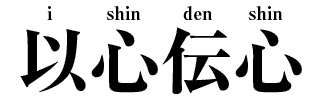
What does the name of our dojo “ishin denshin” mean?

Water: the elixir of life and the secret to optimal hydration
Sempai, Kohai and Dohai: respect for the hierarchical system
What is a dojo (道場)? | At the origins of the word
Mitsu no sen (three points) les trois principals initiatives
Karate Belts: Understanding the Order of Ranks
The concept of “Giri”, a profound moral commitment
Kyokun Martial – In karate there is no first attack.
The social economy at the heart of our martial arts center
