
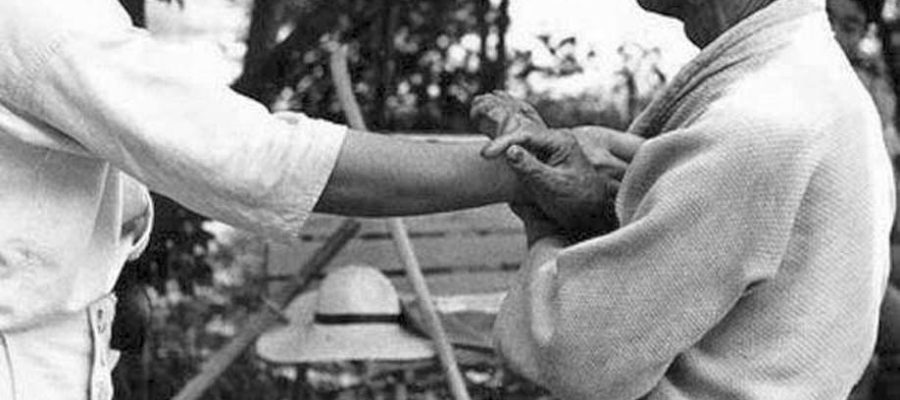
– Toshitsugu Takamatsu Of Masaaki Hatsumi.
Kiho acid represents 8 fundamental techniques transmitted from Takamatsu sensei to Hatsumi sensei as the essence not only of the school Gyokko Ryu Kosshi Jutsu but also as the essence of his entire martial practice. Essence Kiho acid it is found in weapons, bare hands, in all forms of the 9 Bujinkan schools and allows a deep understanding of the multi-level principles Shin – Gi – Tai (technique through the body up to the spirit).
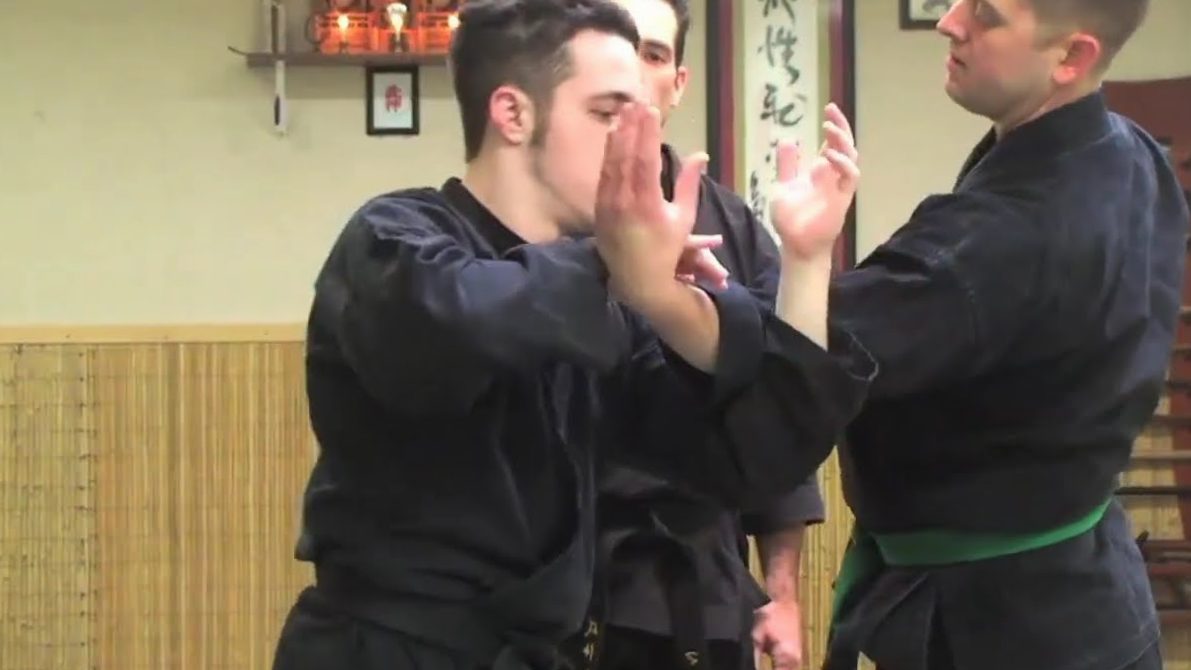
In general it is considered that in the 8 fundamental techniques we have 2 groups divided as follows:
The three basic methods of bone fingering Kosshi Waza Sanpo – 3 techniques to target the cavities, the soft areas of the body
- Ichi(monji) no kata 一文字の構 – more static, simply avoids the attack and counterattacks
- Jumonji no kata Jumonji structure – apar deplasari pe atacuri multiple
- Hicho no kata 飛蔦 の構 – leg techniques also appear, much more stable postures
Five basic manual skills: Torite Kihon Goho – 5 techniques to capture the opponent/grapples
- Omote (kote) gyaku. Reverse side of the table (small hand).
- Ura gyaku (hon gyaku) back
- Musha Dori Capture of warriors
- Dori muzzle Wu Shuangqiu
- Ken Sabaki Kara – Omote Gyaku Fists turned upside down
This last form is interesting because it offers the transition from grappling techniques to a more complex attack (holding and striking). Naturally the model must also be applied to the rest of the forms.
Sometimes it also appears instead of the 5th floor Ganseki Nagewhich can be applied immediately after learning Muso Dori
Other times we find terms Oni Kudaki the technique that is not part of it Gyokko Ryu like Kihon. However we easily find forms of Oni Kudaki practice variations of Musha Dori. Explanation of terms Oni Kudaki AND Goja Dori in Kihon Happo lies in the fact that sometimes the techniques of Roofs are designated by techniques from Kukishin Ryu Daken Taijutsu: Muso Dori it’s kind of Mush din Gyokko Ryu yes Goja Dori which is kind of Government de Gyokko.
Hatsumi-sensei he is known for his skill and inspiration in working with the concepts expressed by Japanese ideograms – Kanji.
This is how Hatsumi Sensei once conveyed the concept of Kiho acid:
気本 発法 – the energy emission technique
奇本 八法 – 8 unconventional/miraculous methods
季翻 初萌 – bear fruit with the changing times (seasons)
And more recently the Soke wrote:
“Those who think that this character Ki (基) in Kihon Happo has only one meaning will not understand the true attitude of Budo Taijutsu.
Scriind cele 4 caractere ale Kihon Happo (Eight basic methods) ca si Kihon Happo (Eight initial methods – awakening present) you will be able to understand the beginning of Taijutsu.
Scriind apoi ca si Kihon Happo (奇本八法– 8 miraculous and unconventional methods) you will be able to see something beyond the idea of tactics, full/empty and TenChiJin strategy.
Scriind ca si Kihon Happo (鬼本八法) you will see the game of demons iar scrind ca si Kihon Happo (生本八法) you will perceive the origin of life”.
Extremely interesting as a meditation topic in subsequent training sessions as well as in everyday life!
Conclusion
The eight fundamental techniques of Gyokko Ryu Kosshijutsu, as transmitted from Toshitsugu Takamatsu to Masaaki Hatsumi, represent far more than a set of physical movements—they are the essence of a living martial tradition. Takamatsu Sensei emphasized that these core techniques, or Kiho, form the foundation from which all other forms and applications arise. By grounding students in these eight principles, instructors ensure that the depth, integrity, and spirit of the art are preserved across generations.
These techniques are not limited to a single style or method; they permeate every aspect of martial practice within the Bujinkan system. Whether executed with weapons, empty hands, or within the framework of the nine Bujinkan schools, the Kiho serve as a conduit to understand the multi-layered principles of Shin-Gi-Tai—the harmonious integration of mind, technique, and body. Mastery of these fundamentals allows the practitioner to move beyond rote repetition, fostering intuition, adaptability, and profound insight into the mechanics and spirit of martial arts.
By treating the Kiho as the cornerstone of training, students develop a disciplined approach that balances precision, awareness, and internal growth. It highlights the idea that martial arts are not solely physical exercises but a pathway to cultivating clarity, focus, and inner alignment. Every strike, every posture, and every movement becomes an opportunity to embody the wisdom passed down through centuries.
Ultimately, the eight foundational techniques of Gyokko Ryu Kosshijutsu are a reminder that true mastery begins with simplicity. By internalizing these essentials, practitioners connect with the very heart of the art, understanding that each form, each application, and each encounter is built upon the timeless principles of body, mind, and spirit—a legacy carefully preserved from Takamatsu Sensei to Hatsumi Sensei, and now to every dedicated student.
latest posts published
What does the name of our dojo “ishin denshin” mean?

Water: the elixir of life and the secret to optimal hydration
Sempai, Kohai and Dohai: respect for the hierarchical system
What is a dojo (道場)? | At the origins of the word
Mitsu no sen (three points) les trois principals initiatives

Karate Belts: Understanding the Order of Ranks
The concept of “Giri”, a profound moral commitment
Kyokun Martial – In karate there is no first attack.
The social economy at the heart of our martial arts center
