
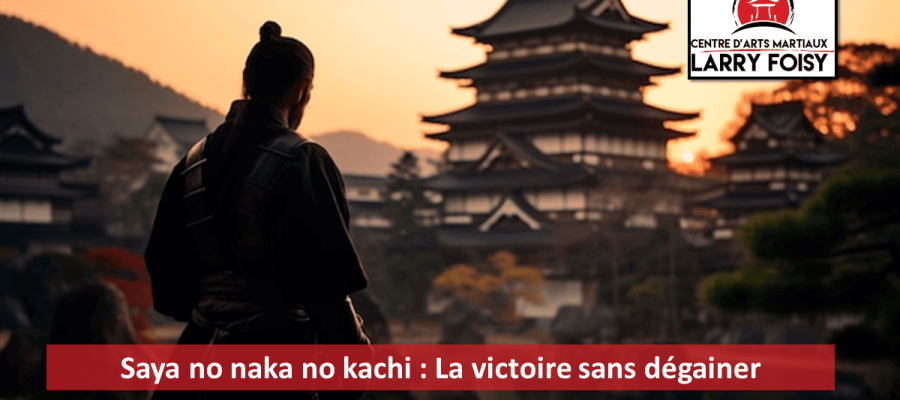
In the teaching of traditional Japanese fighting skills, the concept of I am not naka no kachi (“winning while the sword is still in its cover”) is very significant. It communicates the idea of winning without fighting, of a control that is based not on power or physical confrontations. Although this idea appears to be a great philosophical aim, making it happen is a real challenge, both in practice and in everyday life. How can we then understand and turn this idea into a reality in our martial training and our lives?
The power is present but contained
One path to achieving this invisible victory lies in the development of unwavering martial skill. In his story, the famous samurai Miyamoto Musashi evokes the idea of iwao no mecomparing the warrior to a huge rock balanced on the edge of a cliff. Its mere presence inspires awe, for its latent power is manifest. This principle teaches that mastery of techniques and absolute confidence in one’s abilities confer a dissuasive aura, making any resort to violence superfluous.
However, a force lacking compassion can shift towards an aggressive attitude, creating a climate of confrontation rather than prevention. If we perceive the world through the lens of conflict, every individual becomes a potential threat. But, as the old adage goes, “with your thoughts you build your world”. Seeing the other as an adversary means risking transforming him into an enemy.
Strength tempered by wisdom
The other path to I am not naka no kachi involves developing a calm and thoughtful inner strength. One legend tells of an encounter between Musashi and the Zen monk Takuan Soho, where a poisonous snake approached them while they were meditating near a stream. While Musashi, with his mere presence, scares the snake, Takuan lets the animal slide calmly onto his lap without showing any fear. Musashi, though feared and invincible, realizes that he inspires more fear than respect, while Takuan embodies a peaceful, natural, and even deeper strength.
This story highlights the need for balance: combining unerring martial power with an enlightened understanding of the world. True mastery lies not only in technique, but in the ability to develop a peaceful mind, to manifest serene confidence, and to demonstrate a strength that does not need to be expressed through violence.
Apply to I am not naka no kachi in daily life
In martial practice, training must be a field in which to explore this balance. The goal is to work on highly rigorous techniques and cultivate a kihaku (mental intensity) authentic, but without ever losing sight of the fact that the goal is to achieve serenity. It is this present, yet silent, force that allows us to establish conflict-free relationships, where self-regulation replaces confrontation.
In everyday life, I am not naka no kachi is illustrated by a posture of self-control, firm and benevolent. Face situations calmly and determinedly, without getting involved in unnecessary arguments. Understand that your greatest strength often lies in your ability to defuse a conflict before it even emerges. As an old samurai proverb says: “Only the warrior can choose peace, the others are condemned to it”.
So, both on the tatami and in our daily interactions, we should aspire to this subtle balance between strength and wisdom. It is in this space of mastery and compassion that the true essence of I am not naka no kachi : victory without the need to fight.
Conclusion
The principle of I am not naka no kachi, or «winning while the sword is still in its sheath,» represents one of the highest ideals in traditional Japanese martial arts. Rather than celebrating victory through physical dominance, it teaches that the greatest triumph is preventing conflict before it begins. This philosophy reminds practitioners that true mastery is measured not by the ability to defeat an opponent, but by the wisdom, self-control, and awareness that make fighting unnecessary whenever possible.
At first glance, this concept may seem purely philosophical or even unattainable. However, its true value lies in the mindset it encourages. Martial arts training develops confidence, discipline, and emotional control, qualities that allow practitioners to remain calm under pressure instead of reacting impulsively. A person who possesses genuine skill rarely feels the need to prove it. Their confidence comes from preparation, not from confrontation, enabling them to approach difficult situations with patience and clarity.
Achieving «victory without fighting» does not mean avoiding every challenge or refusing to defend oneself when necessary. Instead, it emphasizes the importance of using intelligence before force. Awareness of one’s surroundings, respectful communication, sound judgment, and the ability to de-escalate tense situations are all forms of martial skill. In many cases, these abilities are far more effective than physical techniques because they prevent harm to everyone involved.
This principle extends naturally into everyday life. Conflicts at work, disagreements within families, misunderstandings among friends, and moments of frustration often present opportunities to practice the same discipline learned in the dojo. Choosing patience over anger, listening before reacting, and seeking peaceful solutions require strength that is every bit as real as physical power. These choices reflect a mature understanding of what martial arts are truly meant to teach.
As practitioners gain experience, they often discover that the greatest opponent is not another person but their own ego. The desire to win arguments, seek revenge, or prove superiority can create unnecessary conflict. By learning to control these impulses, martial artists begin to embody the deeper purpose of their training. They understand that every avoided fight, every peaceful resolution, and every act of restraint is a form of victory that preserves dignity and respect for all involved.
latest posts published
What does the name of our dojo “ishin denshin” mean?

Water: the elixir of life and the secret to optimal hydration
Sempai, Kohai and Dohai: respect for the hierarchical system
What is a dojo (道場)? | At the origins of the word
Mitsu no sen (three points) les trois principals initiatives

Karate Belts: Understanding the Order of Ranks
The concept of “Giri”, a profound moral commitment
Kyokun Martial – In karate there is no first attack.
The social economy at the heart of our martial arts center
