
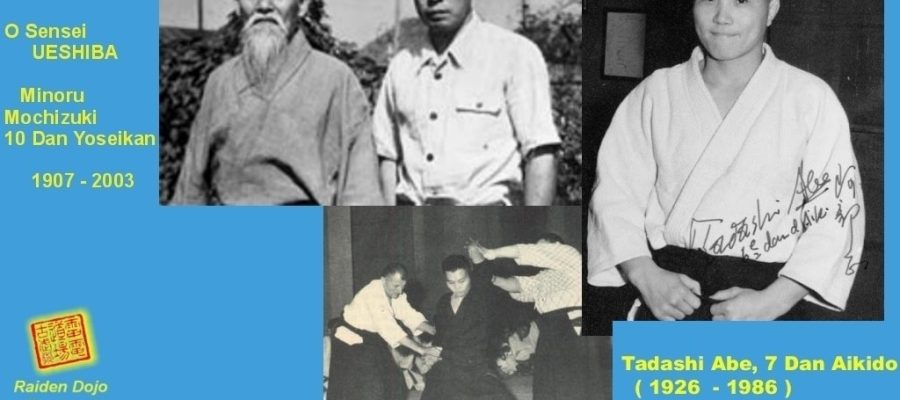
– his post-war dialogue Minoru Mochizuki, 10 Dan (one of his first students OSensei on Aikijutsu Daito Ryu) with Tadashi Abe, 7 Dan Aikido, one of the almost forgotten pioneers of Aikido in Europe
Tadashi Abe has received a certification Today no Koto of Morihei Ueshiba in 1946, thus maintaining the name of the traditional third cartouche Daito Ryu (like Sigo Okamoto was receiving for example Kodo Horikawa). However, it is the moment in which, with the post-war transition, Morihei Ueshiba will continue to issue Daito-ryu certificates flirting with the terminology of Aikido, to free himself from the past represented by Daito Ryu (perhaps above all on a historical and political level).
«Martial arts, rifles and artillery are all Aikido»
However, the concept of Aikido does not seem to belong to Ueshiba. but it was a school unification policy initiated by Japan’s first major martial arts federation – Come on Nippon Butokukai. A certain police officer, Nishikubo, becomes the leader of the DNBK in 1914 and intensely promotes the transition from – Jutsu to – Do mainly as a propaganda method to suggest that the martial art, once the exclusive prerogative of the samurai class, was now available to anyone, the essence being to sacrifice oneself for the Emperor! And things get much more intense in 1930-44 thanks to growing militarism and nationalism.
But let’s get back to Tadashi Abe ea Aikido after the Second World War.
Totally disappointed with the direction his students are taking Morihei Ueshiba after the war, he came in one day Aikikai Hombu Dojohe threw his degree certificates on the table and (after apologizing to the women in the room), declared: «Aikido has become an art for women and old men!».
The story of his meeting with is also absolutely remarkable Minoru Mochizukione of Ueshiba’s first disciples who did not adhere to the modern Aikido of the Aikikai, preferring to preserve the ancient techniques of Aikijutsu Daito Ryuweapons techniques Katori Shinto Ryu and other old schools in what they call Yoseikan Budo.
«Tadashi Abe who died recently – he remembered Mochizuki-sensei. “I met him when I visited the Iwama dojo to greet O-Sensei after my return to Japan at the end of the war. O-Sensei was happy to hear that I had returned safely and welcomed me warmly. I stayed there for the night. That night, a rough-looking man with monk-like haircut entered the room where I was sitting and asked permission to enter. Then he introduced himself:
«My name is Tadashi Abe. Sensei, can I ask you a direct question?» I told him to ask me anything. He asked me if I was really seriously studying Aiki-Jujutsu. At that time the art was not yet called Aikido. When I said yes, he said:
«Is it true? I’ve heard about you, Sensei, for a long time. I heard that you had experience in real combat situations. I think it’s strange that a person like you would feel satisfied with an art like Aiki Jujutsu.” When I asked him why he thought so, he said yes Master Ueshiba OR Saito-sensei they wouldn’t have been able to resist him in a match even for three minutes because he would have defeated them in one fell swoop.
«You’re such a braggart, aren’t you?» I replied. “Are you sure you can beat him Master Ueshiba?» I added. He said he thought it would be easy for him to beat Sensei and added:
«Although I have been observing Ueshiba Sensei for a long time, I have no desire to practice an art like Aiki Jujutsu. I am confident that I can defeat him with one punch. I understand that you highlight real combat, right. ?»
I replied like this:
«I’ve been in a lot of street fights, but I wouldn’t put them in the category of real fighting. I’ve even pulled out a sword and stormed the enemy camp.»
Then he asked me whether Aikido was useful for fighting or not. When I replied to him that Aikido is very useful not only for fighting but also in wartime, he said that my answer did not convince him. So I suggested he attack me and he just stood there telling him to come as he wanted. He asked me to take a prepared position. I told him:
«Don’t say useless things. You can’t defeat your enemy by telling him what to do. Attack me as much as you want!»
Abe muttered, «Sensei, can I really hit you? Strange… you have openings everywhere…» Then he took a stance and suddenly walked straight in. I dodged the blow and kicked him. He groaned and fell. I applied a resuscitation technique and massaged him.
– “How can a person like you faint when barely grazed by a small blow in a fight?”
– «Sensei, does Aikido also have percussion techniques?»
– «Silly! What do you mean by this question? We use kick techniques or something. We also used artillery. Martial arts, cannons and artillery are all Aikido. What do you think Aikido is? Do you think it just means dislocating hands? It is a means of warfare… an act of war is a fight with real swords, because through it we can feel the mind of the enemy coming to attack! So that they respond immediately. Look at that. Sumo. It is the same as Aiki. When a person suddenly faces his enemy in a mental state free from all ideas and thoughts and is immediately able to face him, we call this Aiki. In the old days it was called «Aiki no jutsu«. Therefore, artillery or anything else becomes Aiki.» “Exactly… I think I understand.” “If you still don’t understand, come to me again.” After that he was afraid of me and bowed to me from afar when I left for Europe he asked me to take him with me too.
latest posts published
What does the name of our dojo “ishin denshin” mean?

Water: the elixir of life and the secret to optimal hydration
Sempai, Kohai and Dohai: respect for the hierarchical system
What is a dojo (道場)? | At the origins of the word
Mitsu no sen (three points) les trois principals initiatives
Karate Belts: Understanding the Order of Ranks
The concept of “Giri”, a profound moral commitment
Kyokun Martial – In karate there is no first attack.
The social economy at the heart of our martial arts center
