
Seen as the king of beasts, brave and fierce for Westerners, but for Chinese people, it is kind and mild. Symbolically linked to the dragon, the phoenix, and the Qi Lin (or Kirin, the unicorn in Chinese folklore), the Chinese Lion appeared more than a thousand years ago, coming from India through the spread of Buddhism. Han Wu Ti, the emperor of the Han Dynasty, carried out trade with the West and it was usual to entertain visitors through cultural shows. In one of these events, the performers wore animal heads, but there was no lion head, as this creature did not exist in China. Western traders then brought actual lions and their trainers as presents along the Silk Road.
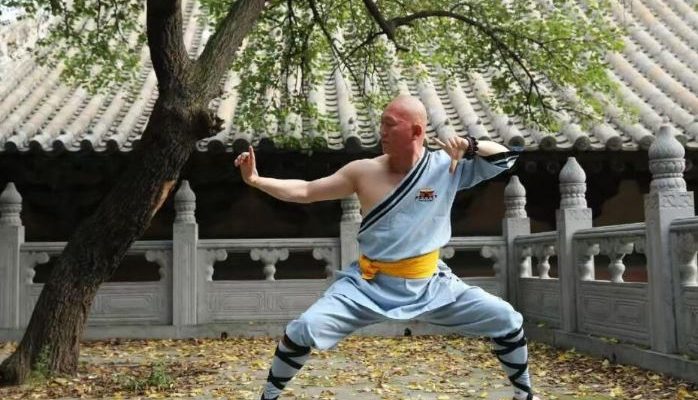
Chinese lion dance is strongly connected to Kung Fu and the dancers are typically practitioners of both. Overall, a school with a lot of lions indicates that it is a very successful establishment. Note! Don’t mix up the Lion Dance with the Dragon Dance, the latter needs many performers. You can allow me to write a specific article about it.
The most used instruments in Lion Dance are the drum, cymbals and gong.
- The horn comes from a bird like the phoenix, which is a symbol of life and regeneration. It also represents the feminine element;
- The ears and tail come from the mystical creature Qi lin or Chinese unicorn which represents wisdom and good luck;
- The spine comes from the snake which represents luck and charm;
- The back of the head comes from the turtle which represents longevity;
- The forehead and beard come from the dragon which represents strength, leadership and the masculine element.
The lion dance
The lion has always been considered the sacred guardian of religion and the dance features elements of Buddhism, Taoism and Confucianism, making it a mysterious and spiritual ritual. Lion Dance has changed throughout history due to the Cultural Revolution, the influence of religions, sports, arts and ethnic groups. Through the Tang, Sung, Yuen, Ming, and Ching dynasties and from the palace to the people, dance became essential in commemorative ceremonies.
Nowadays they can be classified as Northern Lions and Southern Lions, but this was not always the case.
Lions of the North
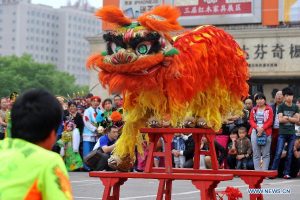 It is believed that in the Northern Wei period from the Yang Tze Kiang region – Northern China – the dance began to spread and was called Northern Wei Lions, which continued until the Southern Song period and became simply called Northern Lions. Because of its long golden fur and dog-like body, the lion also bore the name Jing Shi (Golden Lion). The northern show typically features two adult lions, one or two cubs, and one, two, or three outstanding martial artists to lead.
In addition to being identified by ribbons or coat colors on their heads (red for females and green for males), northern lions perform a dance that emphasizes agility, flexibility, grace and benevolence.
Lions of the South
Coming from north to south, Lion Dance has acquired numerous varieties based on its forms and different characteristics. For example, the Kek clans have bull-like lions and leopards, while the Hokkien have green lions and so on. However, initially there were only two schools, Fut Shan and Hoksan, which mixed with each other and with other Kung Fu styles existing today:
- Fut Shan
- Hoksan
- Futthock
- Oh yes, Ga
- Your good
Southern Lions have become very popular and are native to Guang Dong and are therefore called Cantonese Lions. This style is very much based on the «horse base», a great legacy of its proximity to Kung Fu.
Long ago they were called Rui Lion (Auspicious Lions) and this lasted until the People’s Republic of China. The name changed on May 3, 1928, when many Jingnan were tortured and killed by the Japanese and China was called “The Sick Asians”. The name was changed because the word Rui in Cantonese was pronounced as Shui, meaning to sleep. The new name was Shing which means «awakened» to awaken Chinese nationalism.
Lion colors
Different lion colors are used to give the age and personality of the lion. The white-furred lion is considered the oldest of all, while the yellow-furred ones are the middle-aged ones. The black lion is the youngest of all, whose movements must be more agile or “stubborn” like those of a teenager. Colors can also represent personality, such as: gold indicates liveliness, courage red, and friendship green. However, three specific types of lions still exist, representing historical figures from China and the classic Romance of the Three Kingdoms. [aqui aconselho assistir o filme Red Cliff, Batalha dos Três Reinos] and that he had a blood pact to restore the Han dynasty:
- Guan Gong (Contonese: Kwan Kung) – Known as Xing Shi (醒獅; pinyin: Xăng Shī; “Awakened Lion”), he has a fundamentally red face with black hair and a long black beard (as he is known for his ostentatious beard). The tail is red and black with a white stripe and underside. He is known as the second brother of the triad and sports two coins on his collar.
- Liu Bei (Contonese: Lau Pei, Yue Fei) – Known as Rui Shi (瑞獅; pinyin: Ruì Shī; Auspicious Lion), this is the eldest of the three and has a yellow imperial face (because he became the first emperor of the Shu-Han kingdom) with a white beard and hair (to show his wisdom). He sports a multicolored tail with a white underside, signifying the colors of the five elements, which he controlled because he believed the emperor possessed the blessing of the heavens. The older Liu Bei lions still had black tails. Furthermore, there are three coins on the collar. This lion is often used by schools with a recognized SiFu (Kung Fu teacher).
- Zhang Fei (Contonese: Cheung Fei) – Known as Dou Shi (鬥獅; pinyin: Dòu Shī; “Fighting Lion”), this has a black face with a short black beard, small ears, and black fur. The tail is black and white with a white stripe and underside. Traditionally, this lion also has bells attached to its body, which serve as a warning like the rattle of a rattlesnake. As the youngest of three brothers, he only has a coin around his collar. General Zhang Hei had a short temper and loved to fight, so this lion was used by locals just starting out or those wishing to mount a challenge.
Subsequently, three more lions were added to the group:
- Zhao Yun/Zhao Zi Long (Cantonese Chiu Zi Long) – This one has a green face, black fur and some white details. Also called «The Fourth Brother», he is the Heroic Lion, as Zhao Yun faced Cao Cao’s millions of men to save Liu Bei’s infantry.
- Huang Zong (Cantonese: Wong Tsung) – The body and tail can be yellow or orange with hairs and a white tip. He is considered the Righteous Lion.
- But Chao (Cantonese: Ma Chiu) – This is the white lion due to the color of the bracelet he wore in the battle against Cao Cao – the emperor of the Wei dynasty -, signifying mourning for his father and brother killed by the latter. Therefore, this lion is known to be used for funerals and feathers for important people such as masters or leaders. It is customary to burn the lion after use because it is bad luck to keep it nearby. It is sometimes confused with silver, which can have a whitish color.
All of these mentioned lions, except Liu Bei, are known as the «Five Tiger Generals of Shun», each representing the five elements controlled by Emperor Liu Bei.
Legends of the Lion Dance
A story of “His”
Legend has it that “Nian” (pronounced like Neen) was a ferocious monster who liked to kidnap children. The monster terrorized villages year after year. Finally, in a certain year, a lion defeated the monster and drove it away from the villages. “Nian” promised to return next year. However, this time, the people living in the village no longer had the lion to protect them. So, they solved the problem by creating a lion costume where two people from the village would wear it to scare “Nian”. For this reason, the lion dance is performed every Chinese New Year. Legend also says that the loud sound of the drum, other instruments and fireworks help to scare away the “Nian”. Red is used in New Year celebrations because it is believed that “Nian” was afraid of the color red. The word “Nian” eventually became the Chinese word for year.
The Emperor’s Dream
Another origin of the lion dance is that an emperor of the Tang Dynasty had a dream in which a strange creature saved his life. When he awoke he described his dream to his counselors who informed him that the creature described resembled a lion, a creature of the West. The emperor organized the lion dance in honor of the creature who saved his life. During the Tang Dynasty, lion dancing reached its peak.
The Compassion of Kuan Yin
Another legend describes the lion as a mystical creature that lived in paradise. The lion was such a playful and mischievous creature that it caused the King of Heaven a lot of trouble. As punishment, he cut off the lion’s legs and sent his body to perish on Earth (that’s why the lion costume consists of only the head and tail). Kuan Yin, the Goddess of Mercy, saw the situation and felt sorry for the Lion. He transformed him into the lion by adding mystical elements of different animals to tame him and use the lion’s strength for good.
latest posts published
What does the name of our dojo “ishin denshin” mean?

Water: the elixir of life and the secret to optimal hydration
Sempai, Kohai and Dohai: respect for the hierarchical system
What is a dojo (道場)? | At the origins of the word
Mitsu no sen (three points) les trois principals initiatives
Karate Belts: Understanding the Order of Ranks
The concept of “Giri”, a profound moral commitment
Kyokun Martial – In karate there is no first attack.
The social economy at the heart of our martial arts center
